When hair keeps shedding and looks thinner, the first impulse is often to buy a hair supplement immediately. Yet hair is built from protein, with iron and zinc playing important supporting roles. Genes also affect how each person absorbs and uses iron, which helps explain why some people notice no difference after supplementing it. This article examines which nutrients matter in the nutritional side of hair shedding and how BLNC uses your genes to select formulas so you can spend where it counts.
- Hair loss has many possible causes. Stress, staying up late, and hormonal changes may all play a part; nutrition is only one piece.
- Hair is made almost entirely of protein, so protein provides the foundation, while iron and zinc play important supporting roles.
- When someone takes iron but notices no difference, absorption and gene-related differences in utilization efficiency are often where the process stalls.
- Before choosing hair supplements, identify which area you may be missing. It can save more time and money than buying products one by one to experiment.
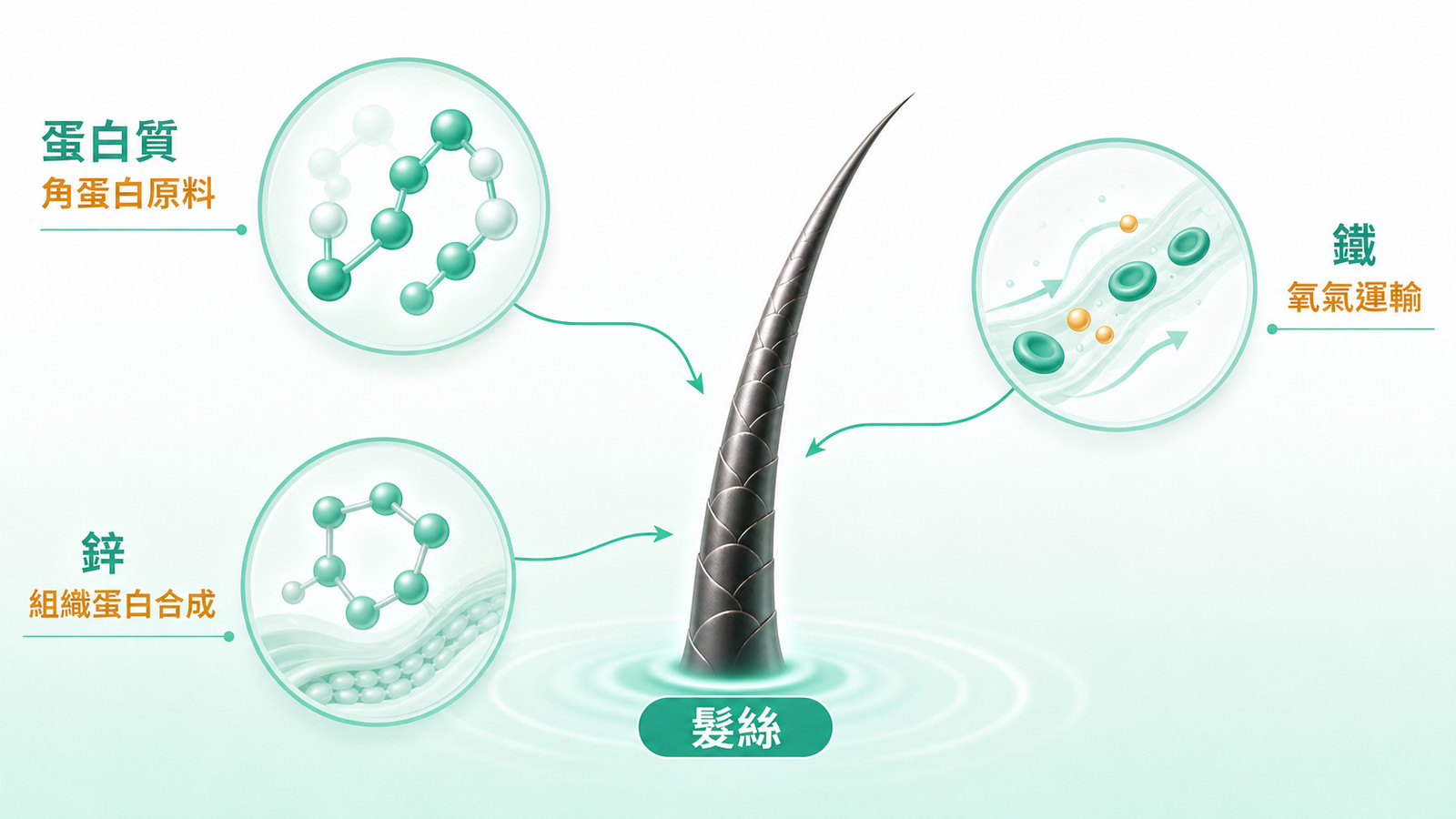
Mapping nutritional gaps associated with hair
A clump of hair collects over the shower drain, and more strands become tangled in your brush. Many people's first impulse is to find a hair supplement. Do not rush. Hair loss has many possible causes: stress, staying up late, seasonal changes, hormonal changes, and inadequate nutrition can all play a part, and nutrition is only one piece. If a large amount of hair falls out over a short period or the scalp is red and itchy, it is more reassuring to see a dermatologist first and then discuss everyday supplementation. This article focuses on the nutritional piece: which nutrients matter, and why some people supplement for a long time without noticing much difference.
Hair is made almost entirely of a protein called keratin, which works like the reinforcing steel in a building. If the body lacks raw materials over the long term, it reserves limited protein for more essential organs, putting hair farther down the priority list. The first step in caring for hair is therefore establishing a sound protein foundation. Two often-mentioned supporting nutrients come next: iron and zinc. Iron contributes to normal red blood cell formation and helps carry oxygen throughout the body. Hair follicles are metabolically active, so hair condition is often among the first places where an inadequate oxygen supply becomes visible. Zinc contributes to protein synthesis in skin tissue and is one of the trace elements hair follicles use in daily function. Establish protein as the foundation and let iron and zinc fill their supporting roles before turning to anything else. (Further reading: How to Supplement Iron for Iron-Deficiency Hair Loss So It Can Be Absorbed)
▸ What Does Research Say About Iron, Zinc, and Hair Loss?
Observational studies have found that iron deficiency, particularly low iron stores, occurs more often alongside nonscarring hair loss. This is observed more commonly in menstruating women and people who follow a vegetarian diet over the long term (Trost et al., 2006). Some studies have also observed low blood zinc levels in a subset of people concerned about hair loss, but this is better understood as one aspect of overall nutritional status than as a single cause. Importantly, these are observational studies. They show an “association” but cannot establish that taking a particular nutrient will improve hair loss. This is why you should understand your nutritional status before accepting every supplement recommendation.
The process usually stalls at one of two checkpoints. The first is absorption. When people consume the same iron-containing foods, the proportion actually absorbed varies widely. Iron from meat is more readily absorbed, while iron from vegetables and legumes needs help from the foods paired with it. “Eating it” is therefore not the same as “obtaining it.” The second checkpoint runs deeper. Genes affect how the body absorbs and allocates iron, and more than one gene is involved. A group of signals must be interpreted together, creating innate differences in nutrient-utilization efficiency. This is also why iron often cannot be supplemented in isolation; nutrients such as vitamin B6 that affect iron utilization need attention as well. The issue is often not a lack of effort, but a direction that does not align with your physiology.
▸ Why Do Bodies Use Different Amounts from the Same Iron Supplement?
Dietary iron comes in two forms. Heme iron from animal foods is generally absorbed at a higher rate than nonheme iron from plant sources. Vitamin C helps increase nonheme iron absorption, while polyphenols in tea and coffee inhibit it (Hurrell & Egli, 2010). Beyond what you eat, genes also influence iron absorption and regulation. Iron-metabolism genes such as HFE create innate differences among people in iron allocation and utilization efficiency. This physiological dimension helps explain why people can respond differently to the same iron supplementation.
Each person's physiology differs, so the directions that need support naturally differ as well. How can you understand your own physiology? That is what the BLNC team works on. Our formula recommendations use a two-layer interpretation. The first examines 22 nutrients, and the second adds a broader range of genetic tendencies so the formulas better reflect your foundation. BLNC is developed by Insight Genomics Inc., a genetic-testing company built on technology transferred from National Cheng Kung University. Its research and development team has long focused on genetic nutrition interpretation, and the Insight Genomics Inc. laboratory oversees every step from specimen handling through analysis. Both approaches may be called customized, but the basis differs: others infer from questions about your lifestyle, while we use your genes to choose.
▸ Is Vitamin D Also Related to Hair?
Experimental studies, including animal- and cell-level work, have observed that the vitamin D receptor participates in regulation of the hair-follicle growth cycle. These are mechanistic and experimental observations and should not be extrapolated directly into efficacy in humans. It is also important to distinguish the factors that primarily determine blood vitamin D levels—sun exposure, absorption, and genes such as CYP2R1 and GC—from how the receptor itself responds. BLNC examines a group of genes rather than just one precisely because these steps can affect one another and need to be interpreted together.
How many formulas do you receive each month? We offer 11 carefully selected formulas and provide you with 6. Probiotics have a fixed place because the gut is a shared foundation for everyone. Your genes select the other 5 from the remaining formulas instead of giving you all 11 at once. The schedule has two stages. Foundational formulas establish your daily nutritional baseline during the first 15 days, followed by enhanced formulas during the final 15 days to provide further support in the directions you need. What changes is “which 5,” not the total. Two people with the same concern about hair loss may therefore receive different sets of 6.
BLNC's Precision Nutrition Approach
So many nutrients can be considered when supporting hair. Instead of trying them one by one until your wallet and patience are exhausted, use your genetic tendencies as a more consistent point of reference.
BLNC offers 11 carefully selected formulas. You receive 6 each month: the probiotic is fixed because the gut is a shared foundation for everyone, while your genes select 5 from the remaining formulas. 3 formulas establish a foundation during the first 15 days, including the probiotic, and 3 provide further support during the final 15 days. This recommendation is selected through a two-layer integrated interpretation of 22 nutrients and a broader range of genetic tendencies.
If your genes indicate that the utilization efficiency of nutrients such as iron and zinc warrants closer attention, relevant formulas containing iron, zinc, and B vitamins will be placed at the corresponding stage among your 5 genetically recommended selections.
Everyone receives probiotics; the other 5 formulas are selected through your two-layer genetic interpretation. Do not miss what you need, and do not buy what you do not.
A genetic report is a reference that helps you understand your body better, not a medical diagnosis. These formulas provide everyday nutritional support, and establishing a sound foundation is what matters. If you have a health condition, continue to follow your physician's advice.
- Schedule a buccal swab—just a few seconds, with no blood draw: Let your genes organize the directions for iron, zinc, and B vitamins that may warrant support, so you no longer have to guess one product at a time.
- Want to See What a Genetic Nutrition Report Looks Like First? Open the example. One test remains applicable over the long term, and setting a direction sooner can save the cost of taking unnecessary detours.
Does Iron Deficiency Always Cause Hair Loss?
Iron deficiency, including low iron stores, is one of the nutritional factors observed to have a stronger association with hair loss. It is particularly worth checking in menstruating women and long-term vegetarians. Hair loss is multifactorial; stress, hormones, and daily routines all play a part. Instead of guessing on your own, understanding your nutritional status before deciding what and how to supplement is both simpler and more precise.
Does Biotin, the “Hair Vitamin,” Really Work?
Results differ among individuals. People who are already deficient are more likely to notice a difference after supplementation, while taking a large amount without a deficiency offers limited additional benefit. The first step is still to identify what you might lack before deciding which area to supplement.
Can Supplements Make Hair Grow Back?
If hair loss is pronounced, see a dermatologist first to determine whether there is an underlying cause that needs attention. This step matters more than any purchase. Everyday nutrition is a separate matter: it supports the raw materials needed for hair growth and is foundational care, not a treatment for hair loss, nor does it guarantee that hair will grow back. After a physician has evaluated the situation, you can begin planning daily supplementation by understanding your physiology better.
Should Long-Term Vegetarians Pay More Attention to Iron Deficiency and Hair Loss?
Yes. Plant-derived nonheme iron is inherently less readily absorbed and benefits from thoughtful food pairing. Estimates for overall diets put iron absorption at about 5–12% for vegetarian diets and about 14–18% for mixed diets (Hurrell & Egli, 2010), so long-term vegetarians do need to pay closer attention to iron stores. Pairing iron-containing foods with vitamin C and avoiding strong tea or coffee immediately after a meal can help. Whether you need an additional supplement and how much still depend on your individual status.
References
- Trost LB, Bergfeld WF, Calogeras E. The diagnosis and treatment of iron deficiency and its potential relationship to hair loss. Journal of the American Academy of Dermatology. 2006. PMID:16635664
- Hurrell R, Egli I. Iron bioavailability and dietary reference values. The American Journal of Clinical Nutrition. 2010. PMID:20200263
- Patel DP, Swink SM, Castelo-Soccio L. A Review of the Use of Biotin for Hair Loss. Skin Appendage Disorders. 2017. PMID:28879195


