DHA is often the nutrient vegetarians and vegans are most likely to miss within the Omega-3 family. The body must process short-chain, plant-derived Omega-3 before it can become DHA, but that conversion is naturally inefficient and is also affected by genetics. This article explains vegan Omega-3 algal oil in plain language: why vegan diets provide very little DHA, how algal oil differs from fish oil, how FADS genes can affect your needs, and how BLNC uses genetics to select the formulas you receive each month.
When it comes to vegan Omega-3 algal oil, many people assume that eating more vegetables and less meat guarantees a balanced diet. In fact, several nutrients are particularly easy to miss. The most common are B12, iron, zinc, calcium, and today's main subject: DHA, a type of Omega-3.
These nutrients should not all be treated the same. Some calcium and zinc can be obtained from dark-green vegetables, legumes, and nuts. B12, however, is found almost exclusively in animal-derived foods, so it is very difficult for vegans to obtain through diet and deserves proactive attention. Plants do contain iron, but it is less readily absorbed. Rather than guessing whether or how much to supplement, you can use genetic clues to help guide you. DHA is found almost exclusively in fish and seafood, so a vegan may go an entire day without consuming any at all.
▸ Why is average DHA lower among vegetarians and vegans? A look at the research
Observational studies comparing vegetarian, vegan, and omnivorous groups have found that vegans have lower average blood levels of long-chain Omega-3s (EPA and DHA) than people who eat fish (Rosell et al., 2005). The reason is not an inadequately nutritious diet, but the near absence of direct DHA sources from that diet.
Keep in mind that this is an average observation across populations. It does not mean every vegetarian or vegan is deficient; an individual's diet and test results still matter.
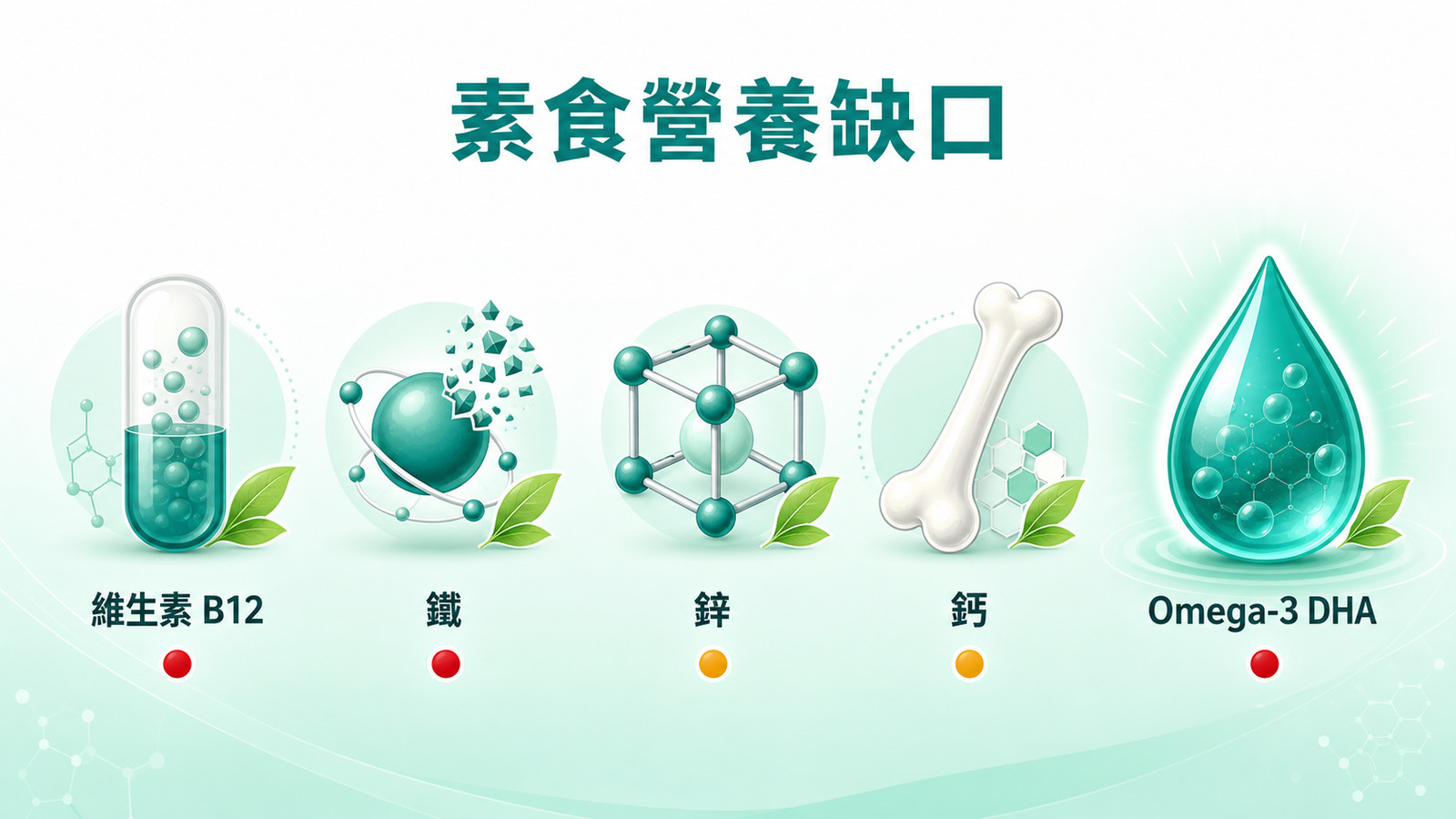
Nutritional Gaps for Vegetarians and Vegans
Why is DHA especially easy to miss on a plant-based diet? Plant Omega-3s, such as those in flaxseeds, chia seeds, and walnuts, are short-chain fats. The body must process them before they become usable long-chain DHA.
It is like buying uncooked rice that must first be cooked before the body can eat it. The problem is that this cooking process is naturally inefficient: for most people, only a single-digit percentage is converted into DHA. That makes it extremely difficult to obtain enough DHA from vegan Omega-3 sources simply by consuming more plant oils.
The problem is not a lack of effort; this metabolic pathway is narrow to begin with.
▸ Why is the efficiency of cooking the rice so low? A look at the mechanism
The primary plant-derived Omega-3 is ALA (alpha-linolenic acid). The body must use desaturase and elongase enzymes to convert it step by step into EPA and then DHA.
Isotope-labeling and dietary studies estimate that the proportion of ALA converted to DHA is usually only in the single digits, and that sex and overall dietary intake affect the conversion result (Burdge & Calder, 2005). It is therefore difficult to obtain enough DHA merely by consuming more flaxseed oil or chia seeds, which is why vegetarians and vegans should pay particular attention to their Omega-3 strategy.
Where can vegetarians and vegans obtain DHA? The answer is algal oil. Fish contain DHA because they eat algae; extracting it directly from cultivated algae simply skips the fish.
The DHA in algal oil is the same molecule as the DHA in fish. Research shows that taking algal-oil capsules and eating salmon have comparable effects on raising blood DHA markers. The difference is that algal oil does not pass through fish, making it a fitting choice for vegetarians, vegans, or anyone who prefers not to use animal-derived sources.
For Omega-3, BLNC uses only algal oil and no fish oil, so it is compatible even with vegan diets. No one needs to use fish oil solely to obtain DHA. If genetic interpretation indicates a need for long-chain Omega-3, algal DHA is scheduled in the enhanced second 15 days. To learn more about Omega-3 and genetic tendencies in lipid utilization, see how to supplement Omega-3 with ApoE4.
▸ Is algal DHA really the same as fish-oil DHA? A look at comparative research
Algal DHA and fish-oil DHA are the same molecule; the only difference is whether the raw material comes from cultivated algae or fish. One human comparative study found that algal-oil capsules and salmon were comparable in raising blood DHA markers (Arterburn et al., 2008). Fish oil often contains both EPA and DHA, two long-chain fatty acids, in ratios that vary by formula, so always check the label.
Because it does not pass through fish, algal oil raises fewer concerns about fishy odors and the accumulation of marine pollutants. However, like fish oil, algal oil still requires attention to purification, antioxidant preservation, and testing quality. Plant-derived does not automatically mean purer.
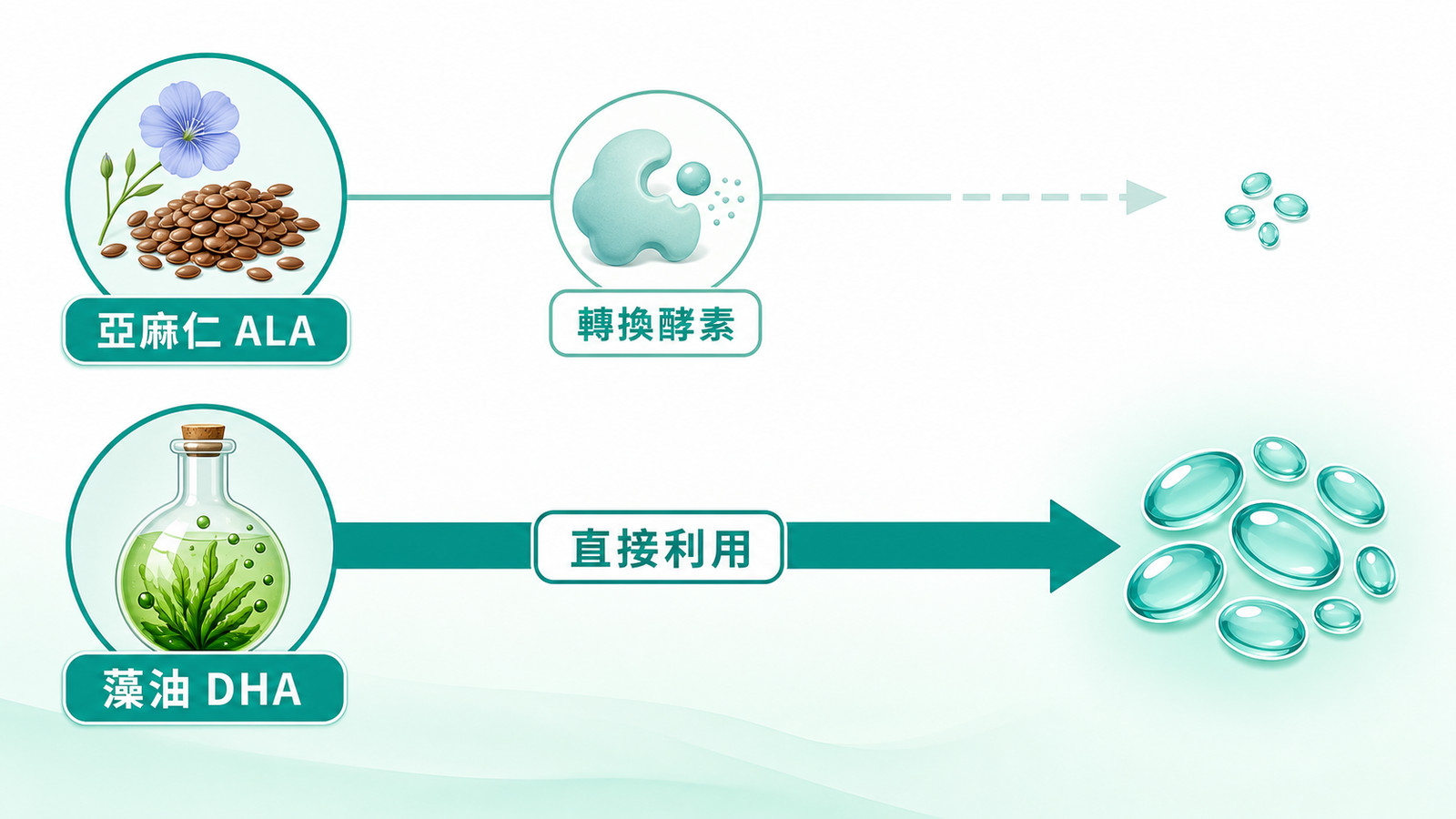
Limits of Plant-Based Omega-3 Conversion
Even on the same plant-based diet, some people convert it relatively well while others convert it poorly and may still obtain too little despite consuming plant oils. Adequacy must also be considered alongside dietary sources and overall nutritional status. One key difference is the power of that rice cooker, which naturally varies from person to person.
A gene family called FADS helps control the power of this machinery. People with stronger activity may convert plant Omega-3 into DHA somewhat more efficiently, while those with weaker activity may struggle to obtain enough no matter how much plant oil they consume.
That is why vegetarians and vegans can differ in how much algal oil they need. Genetic information can help guide you instead of relying only on guesswork.
▸ How does FADS affect conversion, and how does ApoE affect lipid utilization? A look at genetics
The enzymes that process short-chain fats into long-chain fats are influenced by the FADS1 and FADS2 genes. Different genotypes are associated with different desaturase activity and therefore naturally different conversion efficiency (Schaeffer et al., 2006).
People with different FADS genotypes naturally differ in the proportion of long-chain Omega-3 in their blood. However, this is an observational association that is also affected by total dietary intake and sex; it does not mean plant oil alone is sufficient. ApoE, another gene related to lipid utilization, has been associated with how the body uses lipids and Omega-3s and may contribute to differences in individual responses to DHA supplementation (Ebright et al., 2024). These mechanisms remain under study. Genes are associated factors, not determinants, and serve only as a reference.
Which 6 formulas might a vegetarian or vegan receive through BLNC each month? Everyone receives probiotics as a foundation for gut health, and genes are used to select the other 5 from the remaining formulas. The foundational vitamin formula contains B12 at 146% of the Daily Reference Value, directly addressing a nutrient gap for which vegan diets offer almost no plant source. Algal DHA is placed in the enhanced second 15 days only when both genetic and dietary information point to long-chain Omega-3 as a priority.
BLNC is developed by Insight Genomics Inc., a genetic-testing company built on technology transferred from National Cheng Kung University. Its R&D team has focused on genetic nutrition interpretation for years, and its own laboratory personally oversees every step from specimen handling to analysis, helping make your supplementation choices clearer and more reassuring.
▸ How are the 6 monthly formulas arranged? A look at the 30-day approach
BLNC's monthly plan always contains 6 formulas, not all 11. Structurally, 1 standard formula contains 50 billion probiotics and enzymes from 80 Brazilian fruits and vegetables. The other 5 are selected by genetic interpretation from the remaining 10 formulas.
The 30 days are divided into two stages. The first 15 days contain 3 formulas: the standard probiotic plus 1 formula each from the vitamin and mineral categories. These are the foundational category used to establish a daily nutritional baseline. The second 15 days contain 3 formulas that provide enhanced support more closely aligned with individual differences. Algal DHA is a long-chain Omega-3 support option for the second 15 days. It is included in the latter half when FADS-related conversion efficiency and dietary sources together indicate that this nutrient deserves priority.
BLNC uses two layers together to determine your 6 formulas. The first layer inventories the refrigerator, examining how you absorb and use 22 nutrients so your more apparent gaps are identified. The second layer considers your underlying constitution—broader genetic tendencies—to decide which dishes made from those ingredients should be served first.
Only by combining the two layers can the system select the 6 formulas that best fit you. People on plant-based diets are particularly concerned about supplementing in the wrong direction. The basis of personalization matters: others may guess from questions about your habits, while BLNC uses genetic clues to select formulas.
▶ Want to know whether algal DHA may suit your plant-based diet? Search for BLNC on LINE or contact us through the contact form.
▸ How does the two-layer algorithm integrate its findings? A look at the methodology
BLNC formula recommendations have two layers. The first interprets 22 nutrients, including vitamin absorption, mineral metabolism, lipid nutrition, and other metabolic areas. This layer corresponds to the nutritional priorities visible in the report.
The second layer incorporates broader genetic tendencies into an integrated interpretation to adjust the priority of formulas. This is the inborn foundation that questionnaires cannot capture and only testing can reveal. The goal is to avoid making recommendations from a single nutrient alone.
The final output remains 6 formulas per month: 1 standard probiotic, with the other 5 ranked and selected from the genetic results. If long-chain Omega-3 ranks highly, algal DHA enters the enhanced second 15 days. If other nutritional priorities rank higher, the slot is reserved for a formula that better reflects that interpretation.
BLNC's Precision Nutrition Approach
At this point, you may be wondering: If I follow a plant-based diet, should I take algal DHA?
You should not have to guess. Let your genetic nutritional tendencies provide an initial direction.
BLNC gives you 6 formulas each month. Probiotics are standard, and the remaining 5 are selected through a two-layer integrated interpretation of 22 nutrients and broader genetic tendencies.
If your genetic nutritional needs lean toward long-chain Omega-3, algal DHA will be scheduled for the enhanced second 15 days. If other priorities are a closer match, that slot is reserved for the formula you need more that month.
Everyone receives probiotics. The other 5 formulas are selected through your two-layer genetic interpretation. Do not miss what you need or buy what you do not.
A genetic report is a reference that helps you understand your body; it is not a medical diagnosis. These formulas provide daily nutritional support. The priority is a stable foundation. If you have a health condition, follow your physician's guidance.
- Contact us on LINE: Search for BLNC on LINE to discuss your questions about vegan Omega-3 and algal DHA.
- Submit a contact form: Tell us about nutritional gaps in your plant-based diet and your questions about testing, and a team member will contact you.
- Preview a nutrition report: See what a genetic nutrition report looks like and learn which nutritional priorities appear in the two-layer interpretation.
Can flaxseed oil replace algal oil?
Not very effectively. Flaxseed oil provides plant-based, short-chain ALA Omega-3, which the body must process into DHA at an efficiency of only a single-digit percentage. If you want a direct vegan source of DHA, algal oil extracted from cultivated algae is more direct and efficient.
Can both vegetarians and vegans take algal oil?
Algal oil is extracted from cultivated algae and does not pass through fish. It is a non-fish, algae-derived source with less fishy odor, making it a reasonable option for vegetarians and vegans while still providing DHA. If you have a particular history of allergies, evaluate it in light of your circumstances and consult a physician when necessary.
How do I know whether I need algal oil?
Consider two things: whether your diet contains a source of DHA and your genetic conversion efficiency. Through two-layer genetic interpretation, BLNC places algal DHA in the enhanced second 15 days when it fits your needs, helping the 6 monthly formulas align more closely with your nutritional priorities.
References
- Rosell MS, Lloyd-Wright Z, Appleby PN, Sanders TA, Allen NE, Key TJ. Long-chain n-3 polyunsaturated fatty acids in plasma in British meat-eating, vegetarian, and vegan men. American Journal of Clinical Nutrition. 2005. PMID:16087975
- Burdge GC, Calder PC. Conversion of alpha-linolenic acid to longer-chain polyunsaturated fatty acids in human adults. Reproduction Nutrition Development. 2005. PMID:16188209
- Arterburn LM, Oken HA, Hoffman JP, Bailey-Hall E, Chung G, Rom D, Hamersley J, McCarthy D. Algal-oil capsules and cooked salmon: nutritionally equivalent sources of docosahexaenoic acid. Journal of the American Dietetic Association. 2008. PMID:18589030
- Schaeffer L, Gohlke H, Müller M, Heid IM, Palmer LJ, Kompauer I, Demmelmair H, Illig T, Koletzko B, Heinrich J. Common genetic variants of the FADS1 FADS2 gene cluster and their reconstructed haplotypes are associated with the fatty acid composition in phospholipids. Human Molecular Genetics. 2006. PMID:16670158
- Ebright B, Duro MV, Chen K, Louie S, Yassine HN. Effects of APOE4 on omega-3 brain metabolism across the lifespan. Trends in Endocrinology & Metabolism. 2024. PMID:38609814


