When exercise leaves you tired, your legs tight, or your recovery slow, choosing sports supplements takes more than following popular ingredients. Sweating and faster metabolism can increase the use of nutrients such as magnesium and B vitamins. This article explains, in everyday language, how to support magnesium needs and exercise recovery in stages, and how BLNC uses your genes to select the 6 formulas you receive each month from 11 fixed formulas.
Here is the short answer: people who exercise should approach supplements differently from people who are sedentary. It is not because active people are weaker or need to take more, but because sweating and a faster metabolism can make the body use certain nutrients somewhat faster than usual.
Think about cooking a full meal: the higher the flame, the faster you use gas, oil, and seasonings. The body works much the same way during exercise. Magnesium and B vitamins are already used every day, and people with higher activity levels simply use them faster. Which ones should you supplement? That is what this article breaks down. The answer should not be copied from someone else's list; it should reflect your own genetic nutritional tendencies. You may also be thinking of whey protein, creatine, or electrolytes. Those are sports nutrition products aimed at performance and muscle gain, a separate category. BLNC focuses on the more fundamental, often-overlooked nutritional baseline of magnesium and B vitamins. Once the foundation is stable, other sports nutrition can do its part.
▸ Why are people with high activity levels more likely to develop nutritional gaps?
Active people have different nutritional demands from sedentary people for two main reasons. First, sweating and faster metabolism increase the loss of certain minerals, such as magnesium. Second, higher energy metabolism increases the use of coenzymes such as B vitamins. In their 2006 review of exercise and B vitamins, Woolf and Manore noted that people who train regularly may need slightly more of certain B vitamins than generally recommended. People who are highly active and have an unbalanced diet are more likely to develop subtle, mild gaps. As these gaps accumulate, they may affect performance and recovery. This supports a staged approach that establishes a foundation before adding targeted support.
The point is not to load up on supplements just because you exercise. It is to identify where your more apparent gaps lie before deciding how to combine formulas.

Energy in Muscle Cells
Magnesium is a mineral used every day in many reactions throughout the body. When you sweat, magnesium is also lost through sweat and urine. The more you lose, the more important it is for your usual mineral intake to keep pace.
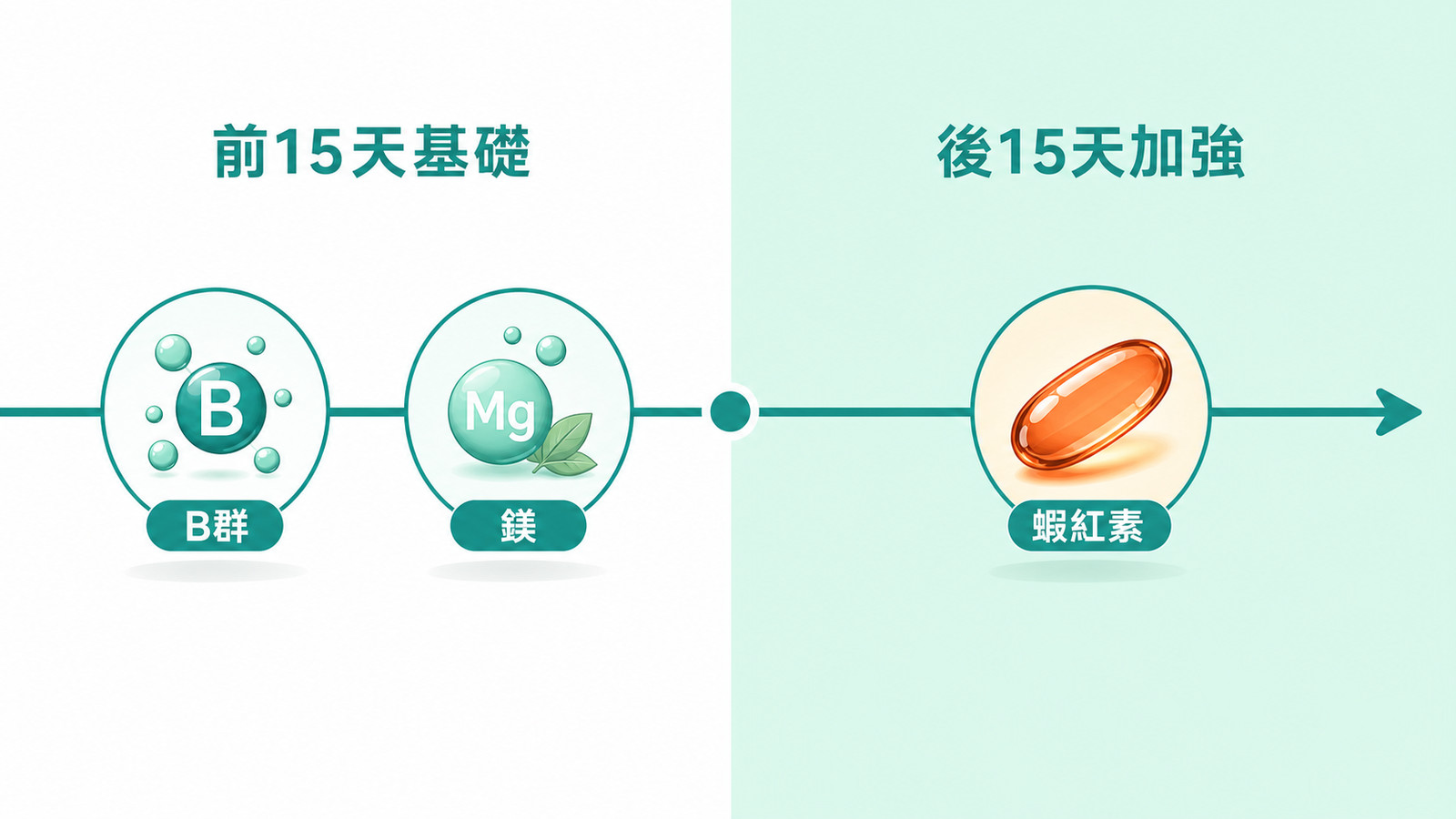
BLNC places Marine Magnesium + 72 Marine Minerals in the foundational category for the first 15 days, supporting mineral intake after sweating. Magnesium is not something to replace only at the moment you sweat; it is part of your daily baseline.
▸ What does research say about magnesium and muscle performance?
Magnesium is a cofactor in more than 300 enzymatic reactions in the body and is extensively involved in energy metabolism and neuromuscular signaling. Magnesium excretion in sweat and urine increases during exercise, and the rise becomes more pronounced at higher intensities (Nielsen & Lukaski, 2006). In a randomized controlled trial of middle-aged and older women, those who took magnesium while exercising regularly tended to perform better in lower-body and general physical activities (Veronese et al., 2014). However, most associations between magnesium and muscle strength come from observational studies, so they show correlation rather than causation. Based on the magnesium content of the Marine Magnesium formula (200mg per capsule, providing 51% of the Daily Reference Value), magnesium contributes to the normal function of the heart, muscles, and nerves and helps maintain normal carbohydrate metabolism.
People with high activity levels often want to add a little more daily wellness support after covering their foundational magnesium and B vitamins. Astaxanthin is one such optional addition and is often discussed in the context of everyday care for stamina and appearance.
Astaxanthin is a reddish carotenoid derived from algae. BLNC places it in the enhanced category for the second 15 days: the first stage establishes a stable foundation before this second stage adds daily wellness support. To learn how to choose this ingredient and who it may suit, see this plain-language guide to the benefits of astaxanthin.
▸ What are astaxanthin's properties and level of evidence, and why should it be taken with a meal?
Astaxanthin is a fat-soluble carotenoid with antioxidant properties. Because it is fat-soluble, it is absorbed better when taken with a regular meal that contains fat, which is why it is often designed to be taken with food. It is frequently discussed in the exercise context because Brown et al. (2017) reviewed research directions involving exercise metabolism, performance, and recovery. However, most human studies have small samples and the evidence is still accumulating, so BLNC positions it as an optional addition for daily wellness. In everyday use, it is commonly categorized as support for stamina, beauty, and appearance. Precisely because it is advanced support, BLNC schedules it for the second 15 days based on an integrated assessment of the overall nutrient analysis and broader genetic tendencies, rather than giving it from the outset.
A quick reminder: take astaxanthin with a regular meal containing fat to support absorption.
Nutrient Timing Around Exercise
B vitamins are a team of vitamins that help convert food into energy. With high activity and greater energy expenditure, the use of these vitamins also increases. If you have recently felt especially tired after exercise, your recovery seems stalled, and your diet is unbalanced, B vitamins are one area worth addressing first.
BLNC's Multivitamin + Enhanced B Complex belongs to the foundational category for the first 15 days. Together with magnesium, it establishes a stable daily nutritional baseline before you assess how tired you feel.
▸ What role do B vitamins actually play in energy metabolism?
B vitamins (including B1, B2, B6, B12, and folate) are essential coenzymes used to convert carbohydrates, fats, and proteins into energy. BLNC's Multivitamin + Enhanced B Complex contains vitamins B6 and B12 and folate. B6 helps maintain normal amino acid metabolism, while B12 and folate contribute to red blood cell formation. When activity levels and energy metabolism are high, the turnover of these coenzymes also increases (Woolf & Manore, 2006), making this baseline especially worth supporting for active people.
Each person receives 6 formulas per month, not all 11 fixed products. Probiotics are included for everyone because the gut is a shared foundation, much like keeping the kitchen sink clear so washing and cooking are less likely to get backed up. Your genes are used to select the other 5 from the remaining formulas. That is the biggest difference between BLNC and guessing your own list: genetic interpretation helps retain the 5 you actually need that month instead of adding products simply because you exercise.
For active people, the foundational category in the first 15 days often includes baseline ingredients such as magnesium and B vitamins to support daily nutrition. In the second 15 days, an option such as astaxanthin may be selected for enhanced daily wellness support. The deciding factor is not whether you exercise, but where your genetic nutritional tendencies lie. Learning about your tendencies first may be easier than repeatedly switching brands and guessing again:
▶ What does a genetic nutrition report look like? A cheek swab takes only a few dozen seconds, with no blood draw. After collection, BLNC uses the results to assemble your personalized formula set.
▸ Why do active people often see magnesium, B vitamins, and astaxanthin?
Nutritional interpretation for active people commonly considers three areas first: mineral loss, demand for coenzymes in energy metabolism, and daily wellness. Woolf and Manore (2006) noted that regular training may increase the need for certain B vitamins. Nielsen and Lukaski (2006) summarized the relationship between exercise and magnesium excretion in sweat and urine. Research on astaxanthin comes largely from small human trials (Brown et al., 2017).
BLNC places these research directions back into the context of your personal genetic nutritional tendencies. Magnesium and minerals establish the foundation; B vitamins reflect energy metabolism needs; and astaxanthin is an enhanced option for daily wellness during the second 15 days. The schedule is based on an integrated assessment of the overall nutrient analysis and broader genetic tendencies, not a test for a dedicated astaxanthin-metabolism gene. Behind this interpretation, BLNC is developed by Insight Genomics Inc., a genetic-testing company built on technology transferred from National Cheng Kung University. Its R&D team has focused on genetic nutrition interpretation for years, and its own laboratory personally oversees every step from specimen handling to analysis, helping make your supplementation choices clearer and more reassuring.
This is also the key difference between BLNC and personalization based only on questionnaires. Questionnaires capture the acquired, changeable layer of lifestyle habits that you can adjust yourself. Genetics adds the unseen, unchangeable foundation that remains with you for life and can help explain why the same training and diet may produce nutritional needs different from someone else's. It adds this stable underlying layer.
BLNC does not add an ingredient simply because it is popular. It begins by understanding your genetic nutritional tendencies. For an active person, the goal is not to take as much magnesium, B vitamins, and astaxanthin as possible. It is to use your nutrient analysis and broader genetic tendencies to identify which type of daily support deserves priority, then reserve the limited enhanced-category slots for those formulas. If you also want to understand how formulas are arranged for people who sit for long periods and do intensive mental work, see how to choose nutrition for sedentary office workers.
▸ What exactly does each layer of the two-layer algorithm examine?
The first layer is nutrient analysis, which appears in the report. It covers 22 nutrients and presents your personal tendencies in areas such as vitamin absorption and mineral metabolism. The second layer incorporates broader genetic tendencies so formula recommendations fit your constitution more closely. For example, the absorption and utilization of nutrients such as folate and vitamin D can be influenced by individual genetic variants. That is why people may differ in how they tend to absorb and use the same nutrient. The result of this two-layer interpretation determines your 5 gene-recommended formulas, which are combined with the standard probiotic, and assigns them either to the foundational category for the first 15 days or the enhanced category for the second 15 days.
BLNC's Precision Nutrition Approach
At this point, you may be wondering: Should I take magnesium, astaxanthin, and B vitamins because I exercise so much?
You should not have to guess. A better approach is to use your genetic nutritional tendencies as an initial reference.
BLNC has 11 fixed formulas. You receive 6 each month: probiotics are standard because the gut is a shared foundation, while your genes select the other 5 from the remaining formulas. The foundational category establishes a baseline during the first 15 days; the enhanced category then supports the areas more relevant to your genetic tendencies during the second 15 days. These recommendations reflect a two-layer integrated interpretation of your nutrient analysis and broader genetic tendencies. To understand the entire approach, begin with this complete guide to precision nutrition.
If your genes indicate a greater need to establish the foundation, Marine Magnesium and B vitamins will appear in the foundational first 15 days. If astaxanthin fits your daily wellness needs, it will be placed in the enhanced second 15 days. A formula that the system does not prioritize will not be included in your combination that month.
Everyone receives probiotics. The other 5 formulas are selected through your two-layer genetic interpretation. Do not miss what you need or buy what you do not.
People who train understand that effort is wasted when it is directed the wrong way. The same applies to supplements. Instead of switching brands and starting the guessing process again every year, spend a few dozen seconds collecting a sample so your money goes toward the formulas you can actually use.
▶ Schedule a cheek swab: It takes a few dozen seconds with no blood draw. After collection, BLNC uses the results to assemble your personalized formula set. ▶ Start your personalized wellness plan: Let your genes select the 6 formulas you receive each month from 11 options, so you do not miss what you need or buy what you do not.
A genetic report is a reference that helps you understand your body; it is not a medical diagnosis. These formulas provide everyday nutritional support. They are not drugs, cannot replace medical advice, and must not be used to address physical discomfort or to prevent, improve, or treat disease. The priority is a stable foundation. If you have a health condition, follow your physician's guidance.
If I exercise a lot, is magnesium all I need?
Magnesium is a common area of nutritional support for exercise, but supplementation should not focus on a single nutrient alone. Sweat, hydration, daily diet, and training volume all affect the strategy. Review your genetic nutritional tendencies first, then decide on a more complete combination.
When is the best time to take astaxanthin?
Astaxanthin is absorbed better with a regular meal that contains fat than on an empty stomach. BLNC places it in the enhanced category for the second 15 days, establishing a foundation in the first 15 days before adding this enhanced daily wellness support.
If I exercise, do I need magnesium, astaxanthin, and B vitamins?
It is better to identify genetic gaps before choosing a combination. The arrangement depends on where your genetic nutritional tendencies lie. BLNC uses two-layer interpretation to select a formula combination that better fits your individual situation instead of adding every popular ingredient.
Is the Omega-3 in BLNC fish oil?
We use algal DHA, not fish oil. The DHA found in fish originally comes from algae. Algal oil is taken directly from that original source and is a non-fish, algae-derived option, making it a reasonable choice for vegetarians or people who prefer not to use animal-derived products. If you have a history of allergies, evaluate it in light of your individual circumstances.
References
- Brown DR, Gough LA, Deb SK, Sparks SA, McNaughton LR. Astaxanthin in Exercise Metabolism, Performance and Recovery: A Review. Frontiers in Nutrition. 2017. PMID:29404334
- Nielsen FH, Lukaski HC. Update on the relationship between magnesium and exercise. Magnesium Research. 2006. PMID:17172008
- Woolf K, Manore MM. B-vitamins and exercise: does exercise alter requirements?. International Journal of Sport Nutrition and Exercise Metabolism. 2006. DOI:10.1123/ijsnem.16.5.453
- Veronese N, Berton L, Carraro S, et al.. Effect of oral magnesium supplementation on physical performance in healthy elderly women involved in a weekly exercise program: a randomized controlled trial. American Journal of Clinical Nutrition. 2014. PMID:25008857


