Genes show innate lipid-metabolism tendencies, while blood tests show current values; the two serve different purposes. Have you taken fish oil for a long time without seeing your numbers change? Before searching for “cholesterol genetic testing,” distinguish medical evaluation of high cholesterol from everyday lipid-metabolism tendencies and the choice of Omega-3 sources. This guide explains in plain language how the two divide the work, and which part BLNC’s nutrition interpretation looks at.
“I have taken fish oil for a year, but my cholesterol still will not come down.” Customer service hears this question every month. First, two candid points: cholesterol is a blood-test marker. A marked family history or persistently elevated blood lipids falls within the scope of medical genetic testing and evaluation by a physician or genetic counselor. For everyday wellness, start by clarifying your nutrition priorities.
So what is the issue with fish oil? If you expect it to lower cholesterol, you may have been watching the wrong marker from the start. Cholesterol is not the marker Omega-3 research usually focuses on, and results across different blood-lipid markers cannot be lumped together. Your innate nutrient-metabolism tendencies are a separate reference, alongside diet, intake, and blood tests.
How does genetic testing differ from blood-test values, and why does it show an innate tendency?
Cholesterol and other blood lipids measured in a blood test are “current values.” They can fluctuate with diet, body weight, season, and even stress; a high value today does not necessarily mean poor underlying capacity. Genetic testing for lipid-metabolism tendencies reads the genotype you are born with, which remains nearly unchanged throughout life, and reflects an “innate metabolic tendency,” such as how efficiently you naturally convert dietary fatty acids into forms the body can use. The two serve different roles: genes show the underlying predisposition, while blood tests show the current state. Together they provide a more complete picture.
Which blood-lipid markers does Omega-3 affect in research?
Blood lipids are not one number. Clinical care and research commonly examine triglycerides, LDL-C (low-density lipoprotein cholesterol), HDL-C, and total cholesterol separately. Omega-3 research examines each of these markers separately, and results differ across sources and fatty acids; when a meta-analysis compared long-chain EPA and DHA with plant-derived ALA, the blood-lipid markers behaved differently (Chen et al., 2020), so the findings should not be reduced to a single answer. This describes a research marker, not a product effect, and does not predict what will happen to an individual.
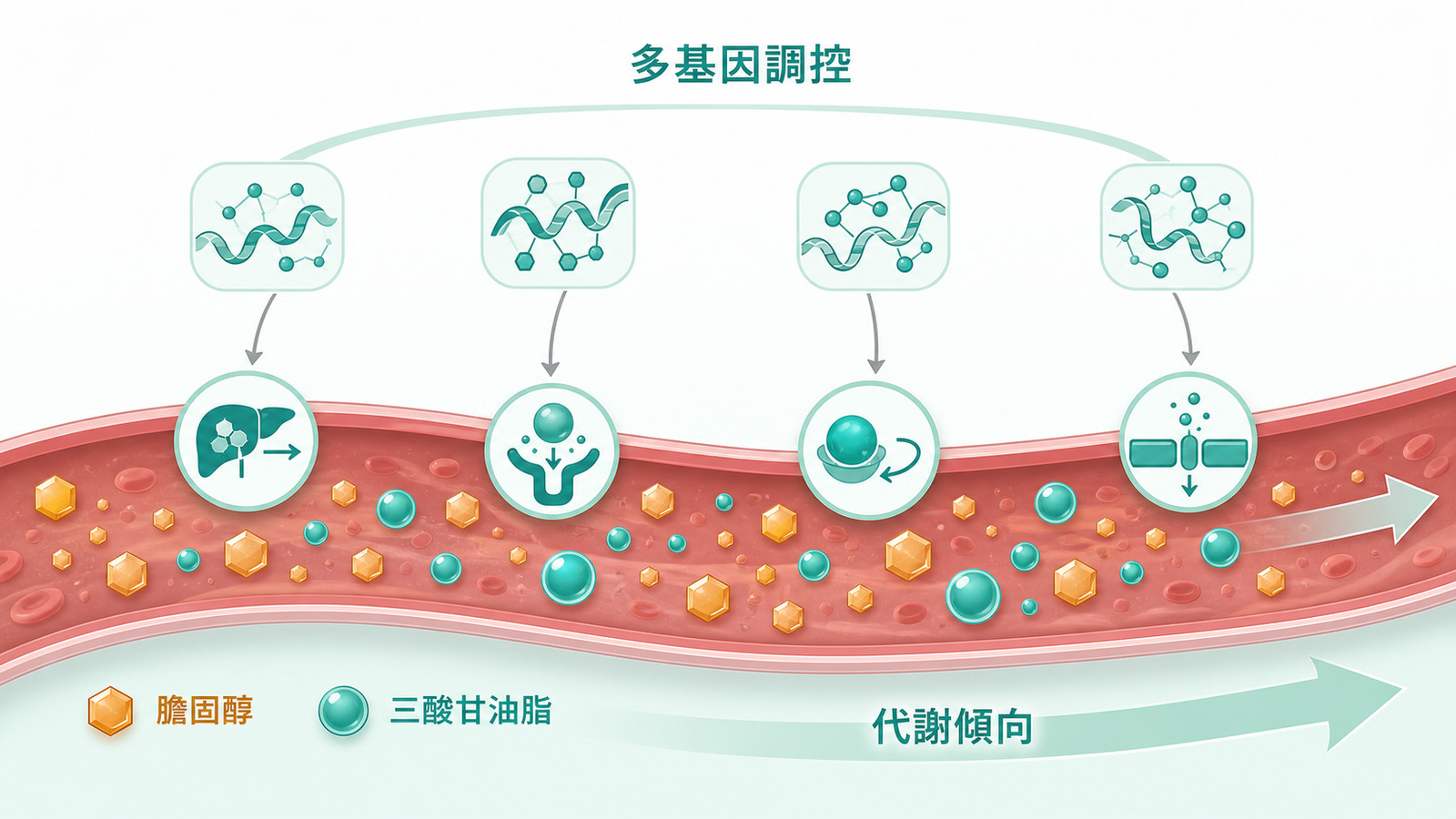
Lipid-Metabolism Tendencies
Understanding lipid-metabolism tendencies is not about finding a switch that determines whether cholesterol is high or low. It is about how the body uses and metabolizes fats. No single gene controls this process; it is more like a kitchen team sharing the work. Some members “process” dietary plant fats into forms the body can use, while others transport and manage lipids in the blood.
If just a few team members are naturally slower, two people with the same diet and the same blood-lipid numbers may still process fats with different efficiency. Instead of fixating on one number, it is more useful to understand which end of the spectrum your innate tendency falls toward.
For that reason, lipid-metabolism tendencies are better interpreted within the overall pattern of nutritional tendencies, not as a conclusion drawn from one gene or one number.
Synthesis, clearance, and transport: three stages of fat processing
The body processes fats through roughly three stages. Synthesis: the liver makes cholesterol according to the body’s needs, and dietary cholesterol is only one source, so eating fewer eggs does not guarantee lower blood cholesterol. Clearance: receptors on the liver capture lipoproteins from the blood for metabolism, and the efficiency of this pathway is reflected directly in blood values. Transport: lipoproteins act like trucks, carrying lipids from the liver to tissues and returning the excess; the makeup and number of these carriers affect transport efficiency. Innate efficiency differs at all three stages, which is why the same diet can produce different blood-lipid patterns in different people.
When people first see that their LDL—often called “bad cholesterol”—is elevated, they may wonder, “Did I eat too much fat, or was I born this way?” Usually both contribute. On the same diet, some people naturally tend to store more while others metabolize fats faster, and innate biological differences are part of the explanation.
Whether cholesterol or LDL is high falls within medical evaluation, where blood-test values serve as the reference markers; BLNC’s genetic testing does not determine whether cholesterol or LDL is high, but looks at nutrient-metabolism tendencies such as fatty-acid utilization. Understanding these tendencies helps you know where to focus when choosing the types and amounts of dietary fat.
Which genes regulate lipid metabolism, and why not name just one?
Terms such as “high-cholesterol gene” and “LDL gene” are broad shorthand. Cholesterol and lipid metabolism involve multiple stages, including synthesis, clearance, and transport, making this a classic model in which many genes each contribute a small effect. Large genome-wide association studies have identified numerous loci associated with blood lipids, supporting a polygenic influence (Willer et al., 2013). A single gene rarely determines the final blood-lipid result. The responsible way to describe this is an “overall metabolic tendency,” not a gene that acts as a switch for whether your cholesterol will be high. The everyday nutrition discussed here concerns the metabolic tendencies most relevant to nutrition (such as fatty-acid utilization), not a determination of whether cholesterol is high.

Considering Omega-3? How to choose between fish oil and algal oil
Once you understand your lipid-metabolism tendencies, you can make more targeted choices about dietary fats. The same foundation applies to everyone: limit trans fats and excessive saturated fats, and use more beneficial unsaturated fats from foods such as deep-sea fish, nuts, and olive oil.
For Omega-3 specifically, it is worth considering the source if you care about dietary preferences or a fishy taste. Fish oil comes from fish. Algal oil comes from microalgae, is an algae-based source, contains no cholesterol, generally has less of a fishy taste, and may better suit people who do not eat fish or follow a vegetarian diet. The difference lies in source and nutrient composition, not in one being able to directly change a cholesterol number. First distinguish the sources; deciding whether Omega-3 should be a daily priority still depends on your lipid-metabolism tendencies and overall needs.
What exactly is the difference between algal oil and fish oil?
Fish oil usually provides both EPA and DHA, whereas algal oil is generally DHA-focused; some products also contain EPA, so check the label. Algal oil and salmon have both been shown to raise DHA markers (Arterburn et al., 2008), and the Omega-3 in fish originally comes from algae in the food chain. The source differs: fish oil is extracted from animals and may raise concerns about fishiness or dietary preferences; algal oil is derived from microalgae, has less fishy odor, is vegan, and contains no cholesterol. For a full comparison of algae-based sources, see How to Choose Plant and Algal Omega-3.
“Slower” does not mean anything is broken. It means your body takes a few extra steps to convert plant-derived Omega-3 into forms it can use. This tendency changes little over a lifetime, so it is worth understanding once.
Several things should be considered together: which fats you usually eat, how often you eat fish, whether you are vegetarian, and your tendency for this conversion. Whether algal DHA belongs in that month’s formulas depends on these dietary circumstances. Clarifying these points before arranging monthly formulas keeps you from returning to the old pattern of trying one bottle after another.
BLNC’s Precision Nutrition Approach
At this point, you have likely separated three ideas: blood tests show current lipid values, genes show lipid-metabolism tendencies, and Omega-3 should be considered in light of its source, your dietary habits, and overall nutritional needs. BLNC brings nutrient-metabolism tendencies into a two-layer interpretation and turns them into priorities for your monthly formulas.
In practice, BLNC arranges 6 of 11 fixed formulas each month: 1 fixed probiotic formula, plus 5 selected by genetic interpretation from the remaining 10; the 6 are split into a foundation group and an enhancement group of 3 each, taken on alternate days. Fatty-acid utilization and the choice of Omega-3 source are considered within the overall nutrition interpretation, and enhanced formulas such as algal DHA are evaluated according to your dietary habits and intake. Cover what you need without buying what you do not.
BLNC is developed by Insight Genomics Inc., a genetic-testing company built on technology transferred from National Cheng Kung University. Its R&D team has focused on genetic nutrition interpretation for years, with its own laboratory overseeing every step from specimen handling through analysis. Think of it as learning more about yourself before deciding where to focus your effort: everyday nutritional care includes both genetic factors and acquired factors such as diet and routine. For more detail on sources, see How to Choose Plant and Algal Omega-3.
How are the corresponding BLNC formulas divided into groups?
BLNC arranges 6 of 11 fixed formulas each month rather than leaving you to choose from a row of bottles. The foundation group covers a shared foundation: probiotics are always included, and the other two foundational formulas are selected through the two-layer interpretation. The enhancement group uses broader genetic tendencies to select 3 enhanced options, with functional ingredients serving as choices for everyday wellness. The two groups alternate day by day, keeping supplementation steady: each formula is taken every other day and spread evenly across the month, rather than concentrated on a few days with nothing on the others.
What data does the two-layer interpretation examine?
BLNC’s first layer examines genetic tendencies related to 22 nutrients, including vitamin absorption, mineral metabolism, and fatty-acid utilization. The second incorporates broader genetic tendencies into a combined interpretation that guides formula ranking, so the 6 selected from 11 fixed formulas align more closely with the individual’s nutritional profile.
Important Disclaimer
Genetic testing is a reference for health tendencies, not a disease diagnosis, and it cannot predict future health risks. A genetic tendency indicates a degree of predisposition; current blood-lipid values still fluctuate with diet, body weight, and lifestyle and must be considered with blood tests and clinical judgment. Supplements provide everyday nutrition and cannot prevent, improve, or treat high cholesterol or any disease. If you have a marked family history, are monitoring health values, or already have health concerns, consult a specialist first.
- Want to know whether BLNC’s interpretation suits your lipid-metabolism tendencies? Search for BLNC on LINE or contact us through the contact form.
- Want to see a sample report first? On LINE or the contact form, note that you would like to preview a nutrition report and learn how it turns genetic tendencies into monthly formula recommendations.
What can genetic testing reveal about lipid-metabolism tendencies?
It reads the genotype you are born with, which remains nearly unchanged throughout life, to help you understand your innate lipid-metabolism tendencies. Genes show the underlying predisposition, while blood tests show current values; the two serve different roles.
If Omega-3 feels different for me, did I buy a fake product?
Subjective feeling alone cannot determine whether a product is genuine; that depends on the source, labeling, and test data, and Omega-3 is not a nutrient judged by how it feels. Keep in mind that fish oil usually contains EPA and DHA, while algal oil is generally DHA-focused, with some products also containing EPA. Both provide preformed, long-chain Omega-3 that the body can use directly. Plant-based Omega-3, such as that from flaxseed, must first be converted in the body, and conversion efficiency varies. If you want a consistent source of DHA, preformed sources such as fish oil or algal oil are more practical.
How does DHA from algal oil differ from fish oil, and is it vegetarian?
Human studies have observed that algal oil and fish sources such as salmon produce similar increases in blood DHA markers. Both fish oil and algal oil can provide DHA directly. Algal oil is an algae-based source, making it a reasonable choice for vegetarians or people who prefer to avoid animal sources. Source selection can still be evaluated according to dietary preferences and professional advice.
I searched for “cholesterol genetic testing,” “high-cholesterol genes,” or “LDL genes.” Is this article about the same thing?
It is related, but this article does not determine whether you will have high cholesterol. People searching those terms usually want to know whether innate differences affect how they process fats. This article distinguishes genetic tendencies, blood-test numbers, and the choice of Omega-3 sources. If your values are abnormal or you have a family history, have a specialist interpret them alongside blood tests.
Can genetic testing for lipid-metabolism tendencies predict future health risks?
No. It presents innate metabolic tendencies, not a script for future health, and it cannot replace medical judgment. Genes describe the foundation for processing lipids, while blood-test values describe the current state. If values are abnormal, are being monitored, or occur alongside a family history, a physician still needs to interpret them with appropriate testing. Genetic testing is better used to understand your biological profile and make everyday nutrition more personally relevant.
References
- Willer CJ, Schmidt EM, Sengupta S, et al.. Discovery and refinement of loci associated with lipid levels. Nature Genetics. 2013. PMID:24097068
- Chen H, Deng G, Zhou Q, et al.. Effects of eicosapentaenoic acid and docosahexaenoic acid versus α-linolenic acid supplementation on cardiometabolic risk factors: a meta-analysis of randomized controlled trials. Food & Function. 2020. PMID:32175534
- Arterburn LM, Oken HA, Bailey Hall E, et al.. Algal-oil capsules and cooked salmon: nutritionally equivalent sources of docosahexaenoic acid. Journal of the American Dietetic Association. 2008. PMID:18589030


