DHA and B vitamins are the two kinds of brain nutrition mentioned most often, and this belongs to everyday nutritional care. Watching older family members or the news, it is natural to search for diets associated with dementia prevention or memory supplements—start by setting realistic, everyday expectations. This article covers the roles of DHA and B vitamins in brain nutrition and why the same fish oil or B vitamins can feel so different from person to person, which also relates to your nutritional profile.
At a certain age, many people begin wanting to do a little more through everyday nutrition. Searches for diets associated with dementia prevention often lead to information about memory-related eating, daily nutrition, and even the genetic background of how the body processes fats. Most people arrive with this concern in mind.
That concern is understandable, and this article is not here to dismiss your motivation. We simply want to keep the focus realistic: everyday care can focus on the nutrients the brain uses each day. Bringing your actions back to daily wellness helps ensure that your effort goes toward what you can realistically support.
In our genetic nutrition research, one of the questions we hear most often is, “Which nutrients does the brain need every day?” Instead of spending your energy fearing a future illness, first understand your own brain-nutrition profile so you can provide appropriate support.
.jpg)
A Two-Group Alternating Everyday Nutrition Plan
You may have experienced this: a friend says fish oil made a difference for them, while you take the same thing and notice little. You switch brands or raise the amount, yet the difference remains small. Many people then assume they are not taking enough and quietly increase the dose again.
But the difference has more than one cause: your existing diet, the dose, how long you have taken it, your health markers, and your nutrient-metabolism tendencies all play a part. Think of the same bag of groceries entering different homes: cooking methods and refrigerator conditions vary, so the final experience does not have to be the same. This is not a matter of willpower—and DHA and B vitamins are not nutrients to judge by subjective feeling in the first place.
This is also why copying someone else’s supplement list has limited value. The brain’s nutritional priorities naturally differ from person to person. Genetic tendencies are somewhat like your body’s nutrient-use instructions, drawing attention to areas that may deserve a closer look. Understanding those tendencies can help show where to focus your effort.
Why say that “small effects from multiple genes add up”? How genetics calculates it
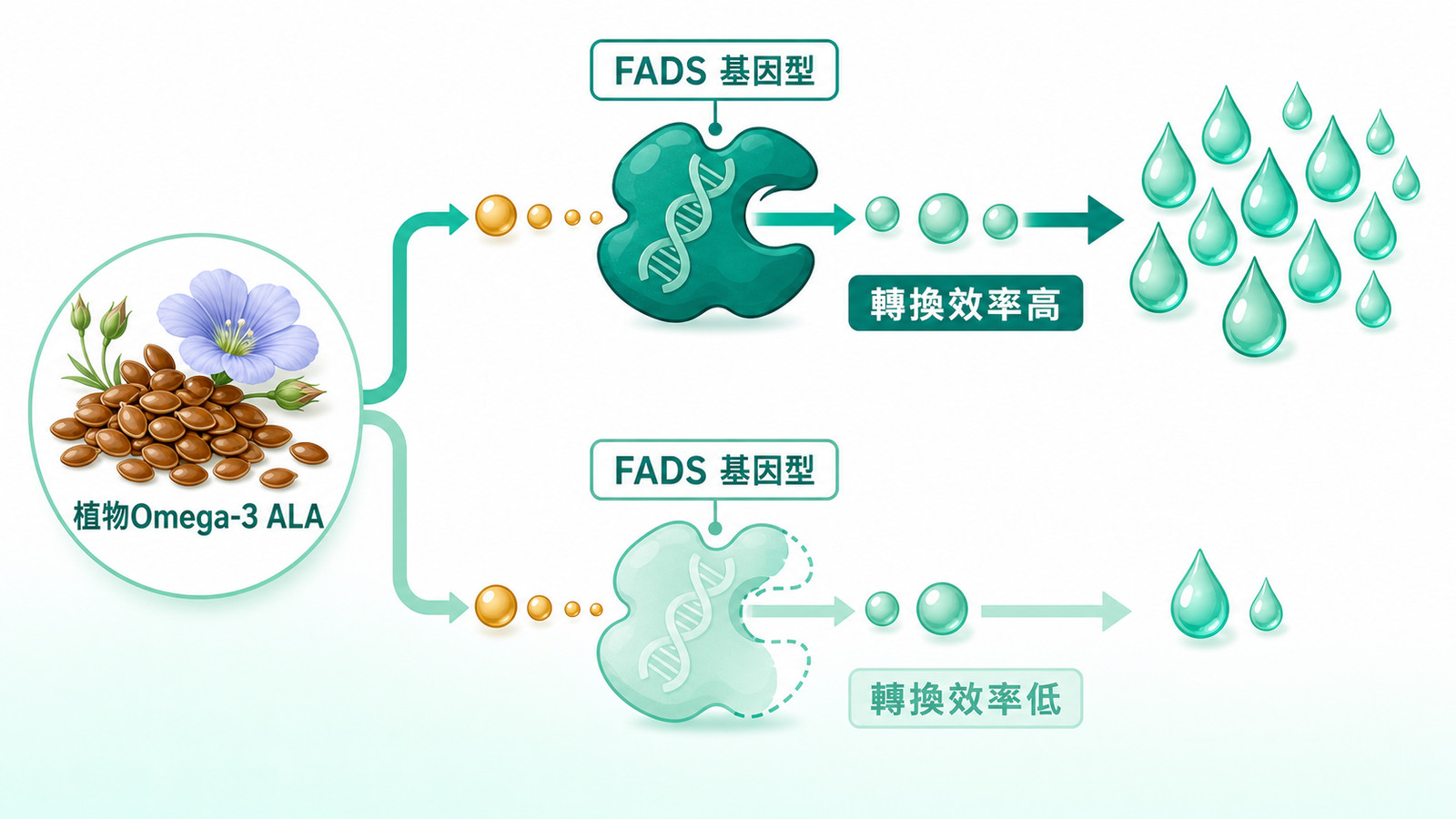
Genetic tendencies related to brain nutrition usually follow a model in which many genes each contribute a small effect rather than one gene deciding the outcome. In nutrient metabolism, for example, the conversion of plant ALA into EPA/DHA relates to FADS1/FADS2, while folate and B-vitamin metabolism relates to MTHFR and other genes; research has observed that different genotypes are associated with fatty-acid composition or nutrient-metabolism markers. Age, metabolic health, and lifestyle then add to the complete picture of a nutritional profile. This is the scientific basis of “personalized nutrition”: a one-size-fits-all approach overlooks individual metabolic differences.
What does genetic testing examine? Genetic tendencies, not a switch for “whether you will become ill”
Many people assume genetic testing simply asks whether you have a “bad gene,” like a black-and-white switch. It does not. Nutrient-metabolism genes usually have several common variants, and the version you carry creates a tendency toward different metabolic or absorption efficiency. This is a difference in degree, not a switch for the presence or absence of disease. Responsible testing therefore examines the “combination of variants” and overall nutritional tendencies, with the focus on understanding nutrient metabolism. The report and qualified professionals should explain the specific items and interpretation.
By now, the idea is likely clear: the issue often is not fish oil or B vitamins themselves, but the fact that people naturally differ in how they handle fatty acids, B vitamins, and everyday brain nutrition. What you should clarify first is not which bottle to buy next, but your own nervous-system nutrition profile—which brain-related nutritional areas your body may need to prioritize.
BLNC examines overall nutrient-metabolism tendencies: which foundational nutrients merit attention first and which source choices belong in daily supplementation.
Separately, research and educational discussions often mention the ApoE gene, which you can think of as a delivery route for fats in the body; its relationship with Omega-3 varies by research context and is an extension of that research background. For the nutrition perspective on ApoE and Omega-3, see How to Supplement Omega-3 with ApoE4. To learn how to obtain DHA used by the brain from algae-based sources, see How to Choose Plant and Algal Omega-3.
One point is essential: a genetic tendency indicates a degree of predisposition, not destiny. Its value is in helping you see which areas deserve more attention and focusing your effort appropriately. The next step is not to rush into increasing the amount, but first to understand the roles that common brain nutrients such as DHA and B vitamins each play.
How does plant-based Omega-3 become DHA, and how can genes affect conversion efficiency?
Consider how the brain obtains beneficial fats. Plant-derived ALA can be converted into EPA and DHA (docosahexaenoic acid), but human conversion efficiency is limited, and conversion to DHA in particular is often considered inconsistent (Lane et al., 2022). Research has also observed that FADS1/FADS2 variants are associated with fatty-acid composition in blood phospholipids (Schaeffer et al., 2006). If the goal is to obtain DHA, direct sources such as fish oil or algal oil are relatively practical.
From Source to Utilization: ApoE and DHA in Nutritional Context
DHA and B vitamins are among the nutrients most often discussed in relation to the brain’s daily needs. DHA is an Omega-3 fatty acid commonly discussed as part of brain and cell-membrane structure and is found in deep-sea fish and algae. Think of it first as one beneficial type of fat commonly found in fish and algal oil that can be included consistently in daily nutrition.
The roles of B vitamins are more specific. Niacin supports the health of the skin, nervous system, mucous membranes, and digestive system, while the legally recognized nutritional function of vitamin B12 is to support nervous-system health. These are clearly describable physiological functions of nutrients and are why B vitamins often appear in everyday nutrition plans.
Knowing which ingredients should be viewed only as everyday nutrition and which have clearly defined nutritional functions brings the discussion back to “what does my nutritional profile call for?” DHA, B vitamins, and other nervous-system nutrition priorities can all inform daily planning.
What does research say about DHA, B vitamins, and the brain?
DHA and B vitamins are often discussed in brain nutrition, but from different perspectives. Many studies have examined DHA, often asking whether fish or Omega-3 intake is associated with measures such as cognitive decline or Alzheimer disease risk. Morris and colleagues, for example, observed an association between fish and n-3 fatty-acid intake and the incidence of new Alzheimer disease (Morris et al., 2003). Most such studies observe an “association” and cannot by themselves prove that DHA caused the outcome. Trials of DHA or Omega-3 supplements have also produced inconsistent results. The more defensible statement is that DHA can be understood within the background of everyday Omega-3 and brain nutrition, but it cannot be described as “DHA prevents dementia.”
B vitamins are often discussed alongside the blood marker homocysteine. When homocysteine is elevated, attention may turn to whether the metabolic cofactors B6, folate, and B12 are adequate. The 2010 VITACOG study by Smith and colleagues examined older adults with existing mild cognitive impairment. It observed the relationship between B-vitamin supplementation and blood markers such as homocysteine (Smith et al., 2010). The focus here is the metabolic relationship between B vitamins and homocysteine, and the study population differs from the general public.
First think of a diet associated with dementia prevention as an everyday plate for the brain: include fruits and vegetables, choose whole grains or mixed grains for staple foods, and rotate protein sources among beans, fish, eggs, and meat. Omega-3 can come from fish, algal oil, nuts, and plant oils. Vitamin B12 commonly comes from animal foods, while niacin is available from meat, fish, whole grains, and legumes. These are lifestyle foundations for nervous-system nutrition, not a way for a single food or supplement to prevent disease.
When should the approach become more personalized? A reasonable sequence is to examine your genetic tendencies and relevant test results first, then consider DHA, B vitamins, and other brain nutrients within your daily plan. Keep the foundation in place and fine-tune it according to nutritional-metabolism tendencies; personalization becomes meaningful when the sequence is right.
Where did the idea that “fish is good for the brain” come from? Observation versus trials
In observational studies, older adults who frequently ate fish rich in Omega-3 had fewer new cases of Alzheimer disease (Morris et al., 2003). This is an “association,” not “causation.” People who eat fish often also tend to have healthier overall diets and lifestyles, making it difficult to attribute the finding to DHA alone. Randomized controlled trials of supplements have produced inconsistent results. A reasonable approach is therefore to treat Omega-3 as an everyday nutritional foundation for the brain. In addition, the efficiency of converting plant ALA into EPA/DHA varies among individuals (related to FADS genotype), whereas fish oil and algal oil provide EPA/DHA directly. This supports a practical sequence: begin with a balanced diet, then base personalized support on individual nutritional-metabolism tendencies.
BLNC’s Precision Nutrition Approach
By now, the central question is probably clear: “Which area should my brain-nutrition profile prioritize?” Advertising should not guess the answer for you. Genetic testing can serve as a reference that makes your daily plan clearer. That is what BLNC does.
BLNC uses a two-layer genetic nutrition interpretation to clarify everyday nutrition. The first layer examines genetic tendencies related to 22 nutrients; the second incorporates broader genetic tendencies into a combined interpretation. Rather than estimating only from lifestyle habits, it adds the genetic profile visible through testing to daily nutrition planning. The report considers Omega-3 sources, B vitamins, and other everyday nutrition priorities in light of your own genetic profile.
This interpretation has an established background. BLNC is developed by Insight Genomics Inc., a genetic-testing company built on technology transferred from National Cheng Kung University. Its R&D team has focused on genetic nutrition interpretation for years, and its own laboratory and team oversee the process from specimen handling and laboratory analysis through nutrition interpretation, making the report’s source and interpretive responsibility clearer.
Instead of trying one product after another until something seems right, first understand your own brain-nutrition profile and direct effort appropriately. You can learn more about BLNC in three ways:
▶ Want to learn whether this interpretation fits your nutritional profile? Search for BLNC on LINE to learn how the two-layer interpretation works.
▶ Use the contact form to contact us: Tell us which aspect of nutrition interpretation you want to understand, and the team will respond.
▶ Request a sample nutrition report: Note “I would like to preview a nutrition report” on the form to see which nutritional priorities the report presents.
After all this, the conclusion is simple: nutrition for the brain includes both genetic and lifestyle components, and the genetic part is something you can learn about. Put worry in its proper place—it can remind you to start taking care of yourself, but that care consists of a balanced daily diet, regular routines, and adjustments to everyday supplementation based on your nutritional-metabolism profile. Keep the foundation in place, and use genetic testing as a reference for areas that may deserve additional attention. You can begin today with a plan that better fits you.
How does the two-layer genetic interpretation produce your monthly formulas?
The interpretation has two layers. The first examines genetic tendencies related to 22 nutrients, and the second incorporates broader genetic tendencies into a combined interpretation that serves as a reference for daily nutrition. In practice, BLNC selects 6 of 11 fixed formulas each month: 1 probiotic formula is fixed, and the other 5 are recommended according to genetic tendencies. The foundation group and the enhancement group alternate day by day, with 1 packet per day and 3 capsules in each packet: each packet holds one capsule from each of that day’s 3 formulas, and the 6 refer to all formulas selected for the month.
Important Disclaimer
Genetic testing is a reference for health tendencies, not a medical diagnosis, and it cannot predict whether you will become ill. Having a family history or certain genetic variants does not mean you will develop a disease, while not having them does not mean zero risk. Supplements provide everyday nutrition and are not drugs; they cannot prevent, improve, or treat dementia or any disease. If you have a family history, noticeable memory changes, or any health concerns, consult a neurologist or other specialist. This information cannot replace medical evaluation.
My parents have dementia. Does that mean I will definitely develop it?
A family history deserves attention, but you do not need to frighten yourself in advance. Treat it as a reminder to care for daily diet, sleep, exercise, and regular monitoring. If you already have noticeable memory changes or remain very concerned, discuss them with a specialist.
What should I do if genetic testing finds a variant that merits more attention?
First, have a qualified professional interpret the result, then consider it alongside your lifestyle and test markers. Establish the basics of a balanced diet, exercise, and sleep, then use your nutritional-metabolism profile to identify brain-nutrition areas that may merit more attention. If disease monitoring is involved, discuss it with a specialist.
Can DHA or fish oil prevent dementia?
Current research cannot say that DHA or fish oil supplements prevent dementia. Fish and algal oil are everyday dietary sources of Omega-3 and can be included as part of a balanced diet.
Are B vitamins related to nervous-system health?
Yes. The legally recognized nutritional function of vitamin B12 is to support nervous-system health, while niacin supports the health of the skin, nervous system, mucous membranes, and digestive system. Research on B vitamins and homocysteine often involves specific populations or people with elevated markers and cannot be applied to everyone. Whether you need additional support can be considered in light of diet, lifestyle, and test markers.
ApoE is often discussed. How is it related to brain nutrition?
ApoE is a protein that transports fats in the brain, and its gene has different variants. Because lipids make up more than half of the brain’s dry weight, ApoE often comes up when research discusses Omega-3, although its relationship with Omega-3 varies by research context. This is research background only; it is not used to predict who will become ill. For the nutrition perspective on ApoE and Omega-3, see this article.
References
- Schaeffer L, Gohlke H, Müller M, et al.. Common genetic variants of the FADS1 FADS2 gene cluster and their reconstructed haplotypes are associated with the fatty acid composition in phospholipids. Human Molecular Genetics. 2006. PMID:16670158
- Lane KE, Wilson M, Hellon TG, Davies IG. Bioavailability and conversion of plant based sources of omega-3 fatty acids - a scoping review to update supplementation options for vegetarians and vegans. Critical Reviews in Food Science and Nutrition. 2022. PMID:33576691
- Smith AD, Smith SM, de Jager CA, et al.. Homocysteine-lowering by B vitamins slows the rate of accelerated brain atrophy in mild cognitive impairment: a randomized controlled trial. PLoS ONE. 2010. PMID:20838622
- Morris MC, Evans DA, Bienias JL, et al.. Consumption of fish and n-3 fatty acids and risk of incident Alzheimer disease. Archives of Neurology. 2003. PMID:12873849


