One set of women's supplements does not fit an entire lifetime. From menstruation through later years, priorities for folate, iron, and calcium change, while form, absorption, utilization, and priority also vary by constitution. Why do the same folate, iron, and calcium supplements seem useful for some people while others notice little? Differences in utilization associated with genes such as MTHFR, HFE, and VDR often contribute. This article explains how genetics can help women choose the right form and direction instead of trying every option.
One of the most common mistakes in choosing women's supplements is using one formula for life. What your body needs changes at ages 25, 35, and 50. Menstruation causes monthly iron loss during younger years. Needs for calcium and folate shift from the reproductive years through menopause, and absorption gradually declines with age. The question is therefore not what women should take, but which nutrients and forms suit you and your constitution now. We will examine the three nutrients women most often supplement one at a time, beginning with folate, which many people take but frequently do not use optimally.
▸ Why did the same routine seem fine before but not now?
As people age, the absorption and utilization of some nutrients gradually change. That is why nutrition strategies often deserve reassessment after midlife rather than continuing unchanged. Women's needs for iron, calcium, and folate also fluctuate from the reproductive years through menopause. Considering both life stage and constitution helps avoid forcing the same formula to work for years. Instead of switching brands based on guesswork, first identify the range of needs that applies to you now.
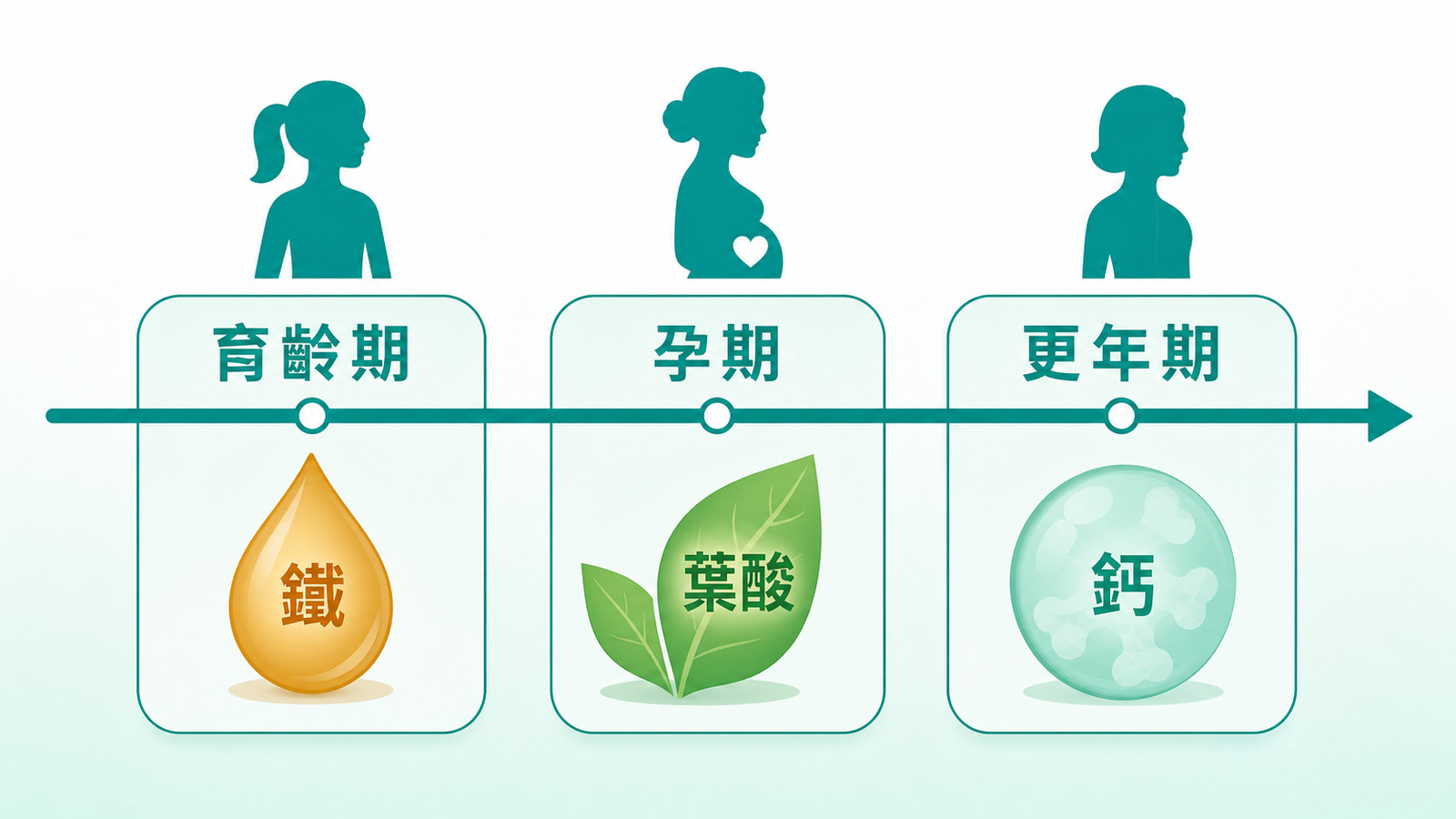
Nutritional Needs Across Life Stages
The body has a folate-processing enzyme called MTHFR. It catalyzes a key later step in folate metabolism that produces 5-MTHF, an active form the body can use directly. Some people naturally have lower MTHFR activity. It is like a rice cooker that does not get hot enough: no matter how long you cook the rice, it remains underdone. Buying more expensive rice will not fix the cooker. For women with this tendency, continually increasing the folic acid dose may be less practical than choosing precooked rice—supplemental 5-MTHF, which bypasses the MTHFR-dependent conversion step. The challenge is that you cannot know how well your processing plant works by feel. Rather than trying every form and wasting money, use genetics to help select the form from the outset. Iron presents the opposite problem: form is not the main issue, and many people take too much.
▸ Why does MTHFR affect folate? A look at the scientific mechanism
The MTHFR enzyme catalyzes a key later step in folate metabolism, converting 5,10-methylene-THF to 5-MTHF. Common variants can reduce this enzyme's activity. Supplemental 5-MTHF bypasses this MTHFR-dependent conversion step. The distribution of common variants in this gene naturally differs across populations and individuals (Wilcken et al., 2003). Folic acid and active folate, or 5-MTHF, are different forms (Scaglione & Panzavolta, 2014). For people with lower conversion efficiency, choosing the appropriate form is more practical than continually increasing the amount. The priority is not a larger dose but first determining whether this tendency applies to you and selecting the right form. That is the first step toward spending on what matters. For a more complete explanation, see how to understand MTHFR and folate genetics.
Many women think of iron as soon as they feel tired, but more iron is not always better. Some people naturally regulate iron absorption and storage differently from most others, in part because of a gene called HFE. Think of iron in the body as a household refrigerator with rules for what enters and leaves. Some people's rules are naturally different, so adding a high dose on their own is not appropriate. Blood markers can be used to assess whether the body has enough iron. Confirming whether you are low is more important than rushing to increase the dose. Excessive supplementation can accumulate and cause discomfort. If you have a genuine concern, leave the assessment to a physician rather than taking high-dose iron on your own. For this reason, BLNC includes iron in its interpretation of the daily nutritional foundation rather than treating high-dose iron as an answer for everyone. Calcium has a different obstacle: even an adequate amount may not enter.
▸ Why shouldn't you simply take more iron? A look at the role of HFE
The HFE gene participates in regulating iron absorption and storage. People with certain variants regulate iron differently from most others (Benyamin et al., 2014). That is why high-dose iron is not suitable as indiscriminate supplementation. The direction should reflect individual constitution rather than encouraging everyone to take a large amount. Determine whether you are low before deciding what to do instead of routinely swallowing high-dose iron. Women's iron balance is naturally under greater pressure during menstruation and other stages, making the right direction more important than a larger amount. For more detail, see genetic differences in iron absorption.
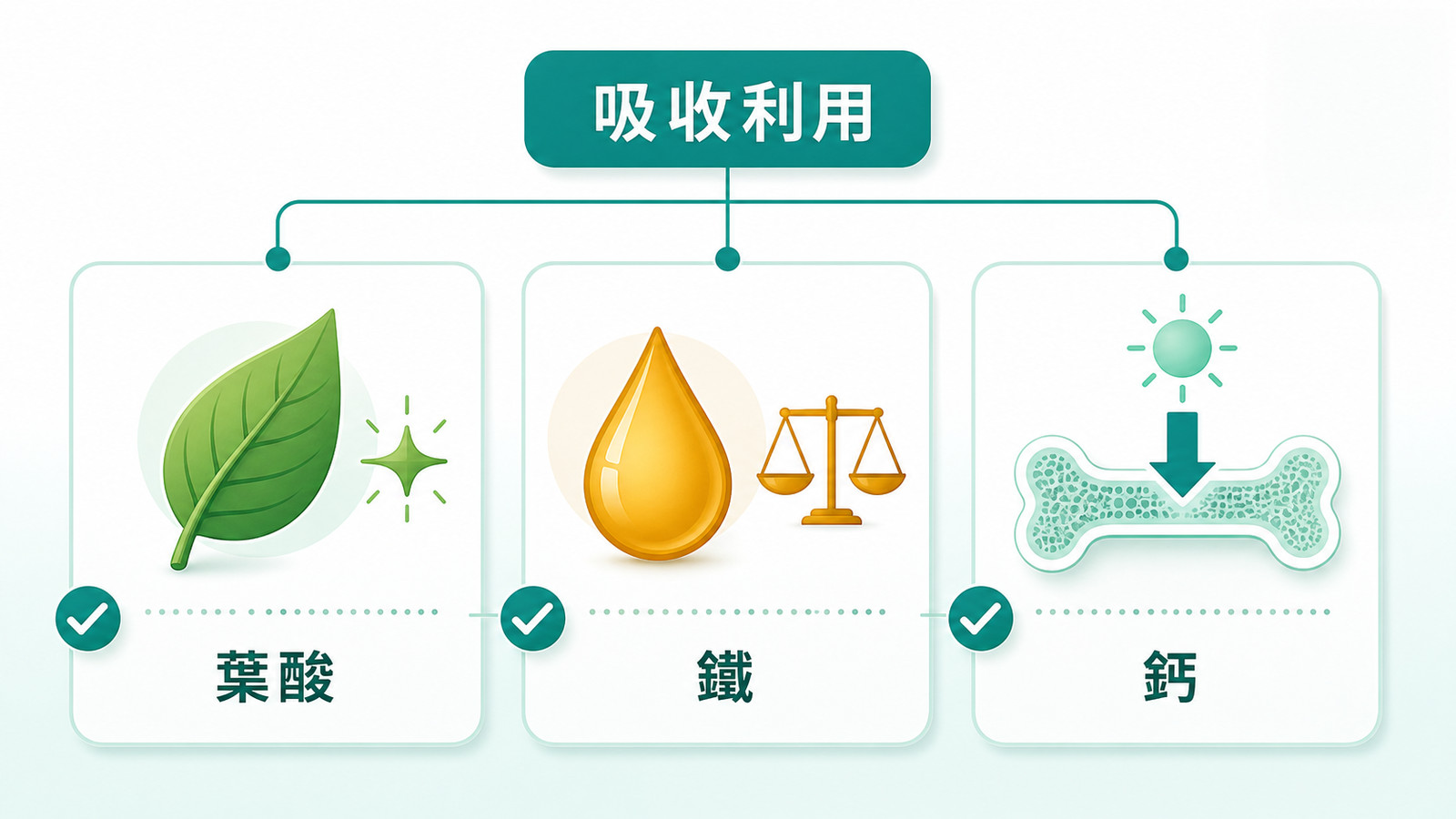
Keys to Absorbing Three Major Nutrients for Women
After midlife, many women begin focusing on bone reserves and take large amounts of calcium without knowing how much is absorbed. Calcium does not enter the body by itself. Vitamin D helps open the door and contributes to increased calcium absorption, while vitamin K contributes to bone calcification. It is like a delivery arriving at your home: without someone to sign for it, the package is returned. The strength of each cell's response to vitamin D is also influenced by a gene called VDR, so the amount of calcium and vitamin D actually used varies among individuals. That is why BLNC combines Milk Calcium + Vitamins D & K instead of providing a single high-dose calcium product.
▸ Why do people still differ after taking calcium and vitamin D? What does VDR do?
VDR influences how strongly cells respond to vitamin D, which in turn affects calcium utilization (Uitterlinden et al., 2004). Blood vitamin D levels, however, are determined mainly by sun exposure, absorption, other genes, and physiological factors—not by VDR—so do not confuse the two. Effective calcium use depends on calcium, vitamin D, vitamin K, and your response to D together. Simply maximizing the calcium dose is not efficient. This is why the formula combines calcium with vitamins D and K. For a more complete explanation, see genetic differences in vitamin D absorption and utilization.
By now, the central point should be clear: women's supplements are not about taking more, but taking the right things. BLNC does not have formulas specifically for women. Its 11 formulas are neutral, and the two-layer algorithm selects according to your genes. Everyone receives probiotics, while 5 more formulas are selected from the remaining pool for a total of 6 each month, divided into two stages. The foundational first 15 days may include formulas such as Multivitamin + Enhanced B Complex or Milk Calcium + Vitamins D & K, depending on interpretation, to establish a stable daily nutritional baseline. During the enhanced second 15 days, formulas support the nutritional directions that genetic interpretation identifies as more relevant. Of the 6, everyone receives probiotics because the gut is a shared foundation. Genetics selects the other 5; which 5 can change, but the total does not.
▶ Want to know how to approach folate, iron, and calcium? Schedule a cheek swab. It takes a few dozen seconds with no blood draw and gives you your genetic nutrition report.
▸ Why combine ingredients and also consider genetics?
Nutrition science increasingly emphasizes synergy rather than simply maximizing one nutrient. Calcium needs vitamin D for absorption and vitamin K to help it be used appropriately, so the overall combination receives more attention than high-dose calcium alone. The same combination can still produce different outcomes in different people. In addition to diet and lifestyle, inborn differences in nutrient utilization at the genetic level are often overlooked. This is why personalized nutrition receives attention and why BLNC uses a two-layer interpretation to select formulas instead of giving everyone the same set.
How do genes help select formulas? BLNC uses a two-layer interpretation. The first layer examines your tendencies in absorbing and using different nutrients and presents them in the report. The second incorporates broader genetic tendencies so formulas align more closely with your constitution. Together, the layers help explain why different women taking the same folate, iron, and calcium may respond differently, with inborn utilization efficiency often contributing. To preview the complete approach, read about genetic precision nutrition interpretation. BLNC is developed by Insight Genomics Inc., a genetic-testing company built on technology transferred from National Cheng Kung University. Its R&D team has focused on genetic nutrition interpretation for years, and its own laboratory personally oversees every step from specimen handling to analysis. This interpretation is not estimated from a questionnaire. Rather than trying formulas one by one, let genetics help establish the direction first.
▸ How does two-layer interpretation differ from questionnaire-based personalization?
Many personalized supplements on the market rely on questionnaires and use your reported routines and diet to estimate what you lack. BLNC is also personalized, but its basis is different: it considers your genotype. The first layer analyzes metabolic tendencies related to 22 nutrients. The second incorporates broader genetic tendencies into an integrated interpretation. Together, the layers select 5 gene-recommended formulas in addition to the standard probiotic for a monthly total of 6. This does not predict or prevent any disease. It helps the monthly formulas align more closely with your constitution. Both approaches are personalized, but others use lifestyle questions to estimate while BLNC uses your genotype to select.
BLNC's Precision Nutrition Approach
After reviewing folate, iron, and calcium—the three nutrients women most often supplement—you have probably noticed that the central question is never how many to take. It is which nutrients and which forms best suit you now.
Rather than trying formulas one by one, use your genetic tendencies as a more stable reference.
BLNC has 11 selected formulas and gives you 6 each month. Probiotics are standard because the gut is a shared foundation, while your genes select the other 5 from the remaining formulas. 3 establish the foundation during the first 15 days, and 3 provide further support during the second 15 days. These recommendations come from a two-layer integrated interpretation of 22 nutrients and broader genetic tendencies.
The foundational first 15 days establish everyday nutrition, while the enhanced second 15 days go deeper in the direction you need to support. The total remains 6 each month, with 3 in each stage; which formulas you receive can change, but the number does not.
Everyone receives probiotics. The other 5 formulas are selected through your two-layer genetic interpretation. Do not miss what you need or buy what you do not.
Remember that a genetic report is a reference that helps you understand your body. It is not a medical diagnosis and cannot predict whether you will develop a disease. These formulas provide daily nutritional support, not medication, and cannot prevent, improve, or treat disease. If you have a health condition, follow your physician's guidance. Once the direction is clear, you can begin adjusting your daily nutrition accordingly.
- Schedule a cheek swab: It takes a few dozen seconds with no blood draw, and one collection remains applicable over time. Metabolism slows with age, and establishing a direction earlier avoids trying every option.
- Start your personalized wellness plan: Everyone receives probiotics. Let your genes select the other 5 formulas from the remaining pool for a personalized monthly total of 6, choosing the appropriate forms from the outset.
Does BLNC offer formulas specifically for women?
No. Our 11 formulas are neutral, and the two-layer algorithm arranges 6 each month. Everyone receives probiotics, while your genes select the other 5 from the remaining formulas. A woman's combination is calculated from her constitution rather than applying a ready-made women's version.
Should I choose folic acid or active folate?
It depends on how well your folate processing plant works. For people with lower conversion efficiency, active folate, or 5-MTHF, is a more reliable source. If you are uncertain, check your genes first. It costs less than trying every type and reduces the chance of supplementing for a long time without noticing a difference.
Can I buy high-dose iron and calcium and take a lot on my own?
Continually taking more is not recommended. With both iron and calcium, the direction and conditions for absorption matter more than pursuing a high dose. BLNC's formulas are designed for daily wellness with this principle in mind.
References
- Wilcken B, Bamforth F, Li Z, et al.. Geographical and ethnic variation of the 677C>T allele of 5,10 methylenetetrahydrofolate reductase (MTHFR): findings from over 7000 newborns from 16 areas worldwide. Journal of Medical Genetics. 2003. PMID:12920077
- Scaglione F, Panzavolta G. Folate, folic acid and 5-methyltetrahydrofolate are not the same thing. Xenobiotica. 2014. PMID:24494987
- Benyamin B, Esko T, Ried JS, et al.. Novel loci affecting iron homeostasis and their effects in individuals at risk for iron overload. Nature Communications. 2014. PMID:25352340
- Uitterlinden AG, Fang Y, van Meurs JB, et al.. Genetics and biology of vitamin D receptor polymorphisms. Gene. 2004. PMID:15315818


