Cardiovascular genetic testing provides an assessment of risk tendencies, not an answer to whether you will become ill; nutrigenetic testing examines nutrient-metabolism tendencies. The two should be considered separately. People who search for this term usually want to know their risk first, but the part you can actually act on is nutrition. This article covers the respective roles of folate, magnesium, and CoQ10, which form of folate to consider, and whether your daily magnesium intake is adequate.
Your experience may be similar: as you reach a certain age, you want to pay more attention to everyday wellness, so you search online for cardiovascular genetic testing and buy folate, magnesium, and CoQ10 along the way. After taking them for a while, however, the uncertainty about whether you chose appropriately remains.
First separate the roles. Cholesterol and blood lipids are markers physicians evaluate through blood tests and clinical assessment. Everyday nutrition can help establish foundations such as folate and magnesium. This article redirects that concern toward “how to set clearer priorities for everyday nutrition.” The same folate or magnesium may feel different from person to person because genes related to nutrient metabolism each contribute a small effect. Age, diet, and lifestyle then add up to distinct biological profiles. Genetic testing does not label genes as good or bad; it examines your underlying nutrient-metabolism tendencies, helping you understand your innate profile and focus your effort appropriately.
The most practical and easiest example to understand is folate.
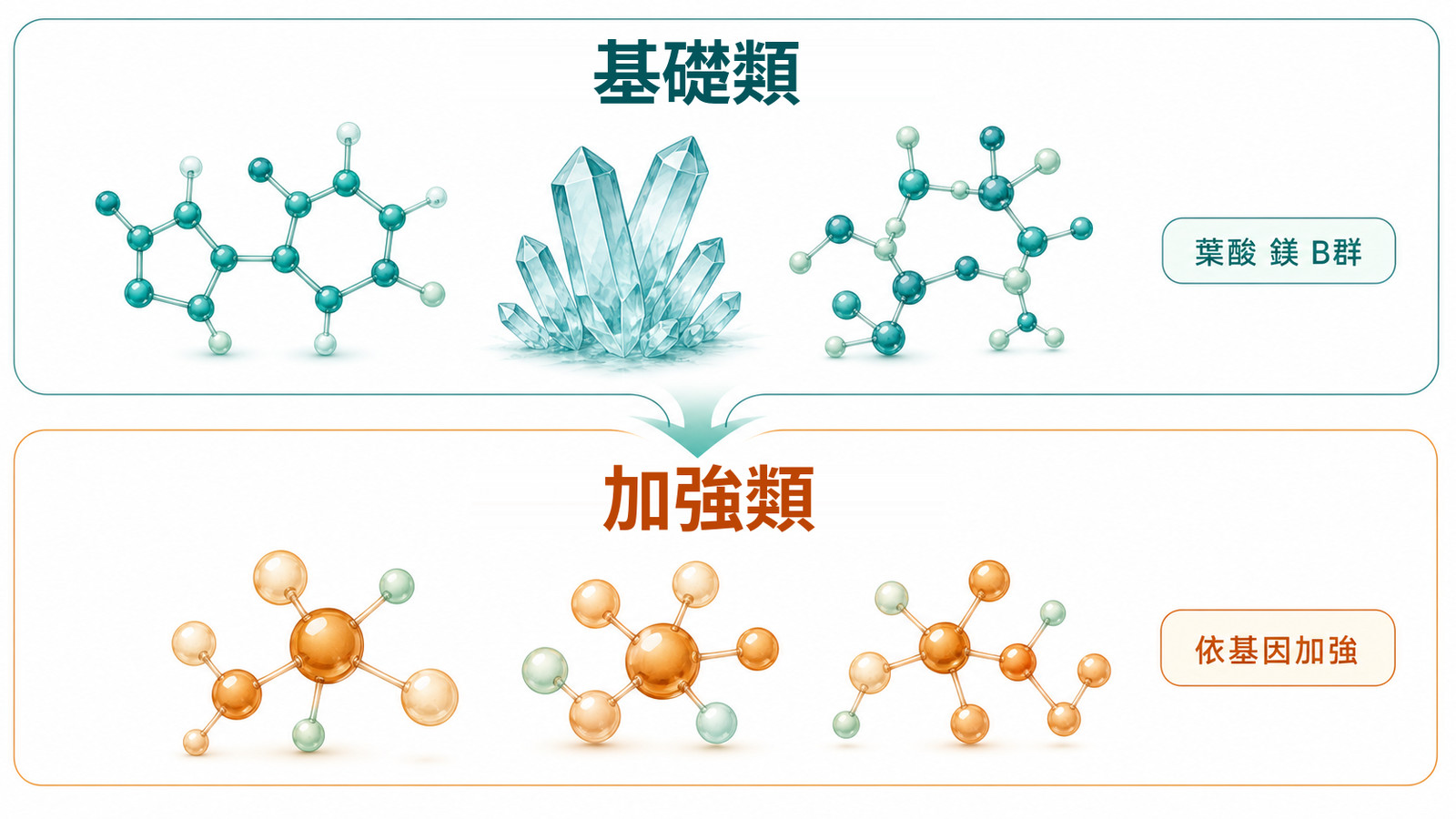
A Two-Group Alternating Everyday Nutrition Strategy
Of the three nutrients, folate has the most substantial body of nutrient-metabolism research. Folate supports two concrete areas. First, the body uses it for blood formation, as it helps form red blood cells. Homocysteine, meanwhile, is a blood marker often used to observe folate, B6, and B12 metabolism; here it is mentioned only as background for understanding nutrient metabolism.
Folate supplementation has a nuance many people do not know. After ordinary folic acid is consumed, the body must “process” it into a usable form—like cooking rice before eating it. A gene called MTHFR is involved in this processing. For some people, this step is naturally slower and conversion efficiency may be lower; however, intake, consistency, and overall B-vitamin status matter just as much, so the key is not taking a lot at once but supplementing a steady amount. To learn whether this applies to you and understand the mechanism, see The MTHFR Gene and Folate Supplementation.
With folate, the priority is therefore a steady, adequate intake, followed by understanding your innate conversion profile. Another often-overlooked foundation is magnesium, which people who eat out commonly underconsume.
Why do some people naturally process folate more slowly? The MTHFR mechanism
The MTHFR gene has several common variants, some of which may produce lower enzymatic efficiency in converting folate into active folate. If both copies of a person’s MTHFR gene are lower-efficiency variants, that person generally merits more attention than someone with only one copy. Other related genes also make smaller contributions along the folate-metabolism pathway. A cross-population study published by Wilcken and colleagues (2003) in J Med Genet found substantial geographic differences in the frequency of folate-metabolism variants, with some Asian populations having notable frequencies. The blood marker mentioned above is formally called homocysteine and is influenced by folate, B6, and B12 metabolism. Here, it is used only as background for understanding nutrient metabolism, not to infer disease. Folate itself also comes in different forms: 5-MTHF (active folate) can be used directly, whereas ordinary folic acid must first pass through this conversion step, and differences between their metabolic pathways have been reviewed (Scaglione and Panzavolta, 2014). For everyday supplementation, the priority remains a steady intake at recommended levels over the long term.
The second nutrient is magnesium. It is a mineral your heart, muscles, and nerves use every day and helps maintain their normal function. Think of it like the bottle of soy sauce in the kitchen—a little is used in many dishes. Yet magnesium is easy to overlook when most meals are eaten away from home and contain highly refined foods. A review of nutrition surveys from several countries also found that dietary magnesium intake was below recommended levels in some populations (Zhang and Zhao, 2025).
Magnesium is therefore not something for an occasional large dose, but a daily foundation many people should keep steady. BLNC’s Marine Magnesium appears among the foundation-group formulas and is included in your monthly formulas when indicated by the interpretation.
Folate calls for attention to processing efficiency, while magnesium calls for attention to daily adequacy. Both are everyday foundations. CoQ10 is another nutrient often discussed alongside them.
How many reactions does magnesium participate in?
Magnesium is the fourth most abundant cation in the human body and a cofactor in more than 300 enzymatic reactions, including ATP energy metabolism, nerve transmission, and muscle contraction. A review published by de Baaij and colleagues (2015) in Physiol Rev describes how intestinal absorption and renal excretion jointly regulate magnesium homeostasis; genes related to magnesium absorption and transport are involved in this process. Magnesium helps maintain normal heart, muscle, and nerve function, corresponding to these foundational physiological roles.

Physiological Roles of Folate, Magnesium, and CoQ10
The third nutrient, CoQ10, differs from folate and magnesium. The body uses it when converting nutrients into energy and can also produce it on its own. Two practical points are that CoQ10 levels in the body gradually decline with age and that it is often discussed in people who take certain prescription medications long term.
But CoQ10 differs from folate and magnesium in another way: it is not among the nutrients examined in the genetic report, so the report will not directly tell you whether to supplement CoQ10. It is included when the formula containing CoQ10 is selected, and actual use still needs to account for age and medication use.
With folate, form matters; with magnesium, daily adequacy matters; with CoQ10, age and medication use matter. Each has different criteria, which is precisely why choosing solely from advertisements can easily lead to poorly targeted choices.
How are CoQ10, age, and medication use related? A look at the mechanism
Coenzyme Q10 (CoQ10) is a key molecule in the mitochondrial electron transport chain that produces ATP and also has antioxidant properties. A review published by Hernández-Camacho and colleagues (2018) in Front Physiol notes that CoQ10 concentrations in the body decline with age. The prescription medications mentioned above are primarily the drugs physicians call statins. A meta-analysis of placebo-controlled trials also observed changes in blood CoQ10 concentrations among people taking statins (Banach et al., 2015). This is why CoQ10 is often discussed in the context of age and medication use.
Advertisements alone cannot easily tell you how to approach folate or whether foundational nutrients such as magnesium should receive priority. Understanding your own metabolic profile first can make your nutritional priorities much clearer.
One oral swab reads your metabolic tendencies. The interpretation has two layers: it first examines your genetic tendencies related to 22 nutrients, then considers them alongside broader genetic tendencies so the formulas align more closely with your genetic profile. BLNC has 11 fixed formulas and arranges 6 each month: 1 probiotic formula is fixed, while the other 5 are selected according to genetic tendencies, bringing relevant nutritional priorities into the plan.
The schedule is also structured: the foundation group and the enhancement group alternate day by day, keeping supplementation steady: each formula is taken every other day and spread evenly across the month, rather than concentrated on a few days with nothing on the others, in a 30-day cycle. Rather than buying another round of products each year based on advertisements, look at your genes once:
- Schedule an oral swab now: It takes only a few dozen seconds, involves no blood draw, and can be completed at home. BLNC will use your genes to select 6 formulas each month and provide your own metabolic-profile report.
- View a sample report: First learn how 22 nutrients are interpreted and turned into monthly formulas, then schedule an oral swab to receive your own results.
How far does the current evidence for “gene-guided nutrition” extend?
Nutrigenetics examines how genotype influences individual nutrient needs and responses. Examples include folate-metabolism variants and genes related to magnesium absorption and transport, which inform interpretation of an everyday nutrition foundation. Research on whether nutrient supplementation changes health outcomes includes both observational studies and trials, and the evidence is not uniform; association does not equal causation. Genetic information should therefore be positioned as a tool for setting clearer priorities for everyday nutrition alongside a balanced diet and regular routine.
The team and background behind this interpretation
BLNC is developed by Insight Genomics Inc., a genetic-testing company built on technology transferred from National Cheng Kung University. Its R&D team has focused on genetic nutrition interpretation for years, with its own laboratory overseeing every step from specimen handling through analysis, so you can understand your supplementation more clearly and feel more confident about it. Integrating academic work, laboratory analysis, and algorithmic interpretation is intended to turn genetic data into actionable everyday nutrition rather than leave it as an incomprehensible report. Formula recommendations use a combined two-layer interpretation: first examining tendencies for 22 nutrients, then considering them alongside broader genetic tendencies. This adds a layer that questionnaires cannot capture and only testing can reveal, allowing the 6 monthly formulas to align more closely with your genetic profile.
BLNC’s Precision Nutrition Approach
Folate, magnesium, and CoQ10 each have foundational physiological roles and form part of everyday nutrition planning. The true foundation remains a balanced diet and regular routine, including walking and physical activity; supplements can only build on those daily habits.
Learning your innate metabolic profile first, then setting clearer priorities for monthly nutrition and maintaining the foundation one day at a time, is the most practical place to start. Wanting to feel more confident about daily nutrition is natural. Instead of buying another round of products by feel each year, schedule one oral swab and let BLNC select 6 monthly formulas according to your genetic tendencies. To establish the concepts first, see the Complete Guide to Precision Nutrition.
One final candid reminder: genetic testing evaluates genetic tendencies; it is not a disease diagnosis and cannot predict whether you will become ill. Carrying certain variants does not mean you will develop a disease. Supplements provide nutrition for everyday wellness and are not drugs; they cannot prevent, improve, or treat any disease. If you have a family history, substantial changes in health-screening values, or anxiety about the results, consult a specialist. The physician can evaluate your complete circumstances so you can arrange everyday nutrition with greater confidence and clarity.
Will cardiovascular genetic testing tell me whether I will develop cardiovascular disease?
This type of genetic testing provides a risk assessment, not an answer to whether you will develop a disease. Risk assessment compares your innate conditions with those of most people and describes a tendency as relatively higher or lower; it does not make a diagnosis or provide a timetable. Cardiovascular disease is rarely determined by one gene. It more often results from the combined effects of many genes together with acquired factors such as age, diet, routine, blood pressure, and blood lipids. A higher tendency therefore does not mean disease is inevitable, while a lower tendency does not provide immunity.
Should people with less-efficient MTHFR variants take active folate?
These individuals convert ordinary folic acid into an active form such as 5-MTHF less readily, so nutrition discussions consider differences among folate forms. Whatever the form, supplementing a steady amount consistently is usually more practical than rushing to switch forms. MTHFR tendencies can serve as one reference for understanding your type, rather than choosing from advertising.
If I take statins long term, can I add CoQ10 on my own?
Do not decide on your own, and do not adjust medications or supplements yourself. CoQ10 needs to be considered in light of the medication, dose, health status, and markers your physician is monitoring. Ask the prescribing physician first.
Can genetic testing help if a health screening shows elevated cholesterol or blood lipids?
Cholesterol and blood lipids are clinical markers evaluated by physicians, so a physician should interpret the numbers; genetic testing does not replace that assessment. Genetic testing helps with something else: understanding your nutritional-metabolism profile so everyday nutrients such as folate and magnesium can be approached with clearer priorities. To learn more about lipid metabolism, continue with What Does Cholesterol Genetic Testing Examine?.
Does everyone receive the same formulas after genetic testing?
No. BLNC has 11 fixed formulas and selects 6 for you each month: 1 probiotic formula is fixed, and the other 5 are recommended according to genetic tendencies. Each person’s 5 are different, and once they are set, they stay the same every month.
References
- Wilcken B, Bamforth F, Li Z, et al.. Geographical and ethnic variation of the 677C>T allele of 5,10 methylenetetrahydrofolate reductase (MTHFR): findings from over 7000 newborns from 16 areas world wide. Journal of Medical Genetics. 2003. PMID:12920077
- de Baaij JH, Hoenderop JG, Bindels RJ. Magnesium in man: implications for health and disease. Physiological Reviews. 2015. PMID:25540137
- Scaglione F, Panzavolta G. Folate, folic acid and 5-methyltetrahydrofolate are not the same thing. Xenobiotica. 2014. PMID:24494987
- Hernández-Camacho JD, Bernier M, López-Lluch G, Navas P. Coenzyme Q10 Supplementation in Aging and Disease. Frontiers in Physiology. 2018. PMID:29459830
- Zhang W, Zhao Y. Global Dietary Magnesium Deficiency: Prevalence, Underlying Causes, Health Consequences, and Strategic Solutions. International Journal for Vitamin and Nutrition Research. 2025. PMID:41504160
- Banach M, Serban C, Sahebkar A, et al.. Statin therapy and plasma coenzyme Q10 concentrations--A systematic review and meta-analysis of placebo-controlled trials. Pharmacological Research. 2015. PMID:26192349


