After taking calcium tablets for three to five years, do your bone-health markers still need monitoring during menopause? The issue is often not a lack of effort, but how menopause supplements are chosen and combined. For the body to use calcium, vitamin D must support its absorption and vitamin K must contribute to bone calcification. Your tendencies in using vitamin D and calcium are also related to the VDR gene. This article explains in plain language why calcium supplementation during menopause should not be chosen by brand alone and how genetics can serve as a reference for pairing calcium with vitamin D and prioritizing formulas.
Your menopause supplements may already fill several bottles: calcium, vitamin D, B vitamins, and fish oil. After taking them consistently for three to five years, you may return for a checkup and learn that your bone-health markers still need monitoring. It is natural to wonder whether you bought the wrong products.
In most cases, the problem is not a lack of effort. After menopause, the way the body retains and uses calcium differs from when you were younger. The proportion of the same calcium tablet that your body can use varies with the combination and your constitution. Rather than switching brands repeatedly, consider an earlier question first: Which supplementation approach actually suits your body? Part of the answer lies in your inborn genetic tendencies, and that is the distinctive starting point for BLNC.
▸ Why do bone reserves deserve particular attention after menopause?
Estrogen helps protect bone. After menopause, estrogen naturally falls and bone resorption becomes relatively more active, so bone density can decline faster than before during the first several postmenopausal years, although the rate varies by site and population. With advancing age, the intestine's capacity for active calcium absorption also gradually declines, while lower estrogen makes bone calcium easier to lose (Riggs et al., 2002). That is why calcium sources and combinations require more attention after menopause instead of simply increasing the dose. These are general trends in nutritional physiology, and individual differences are substantial.
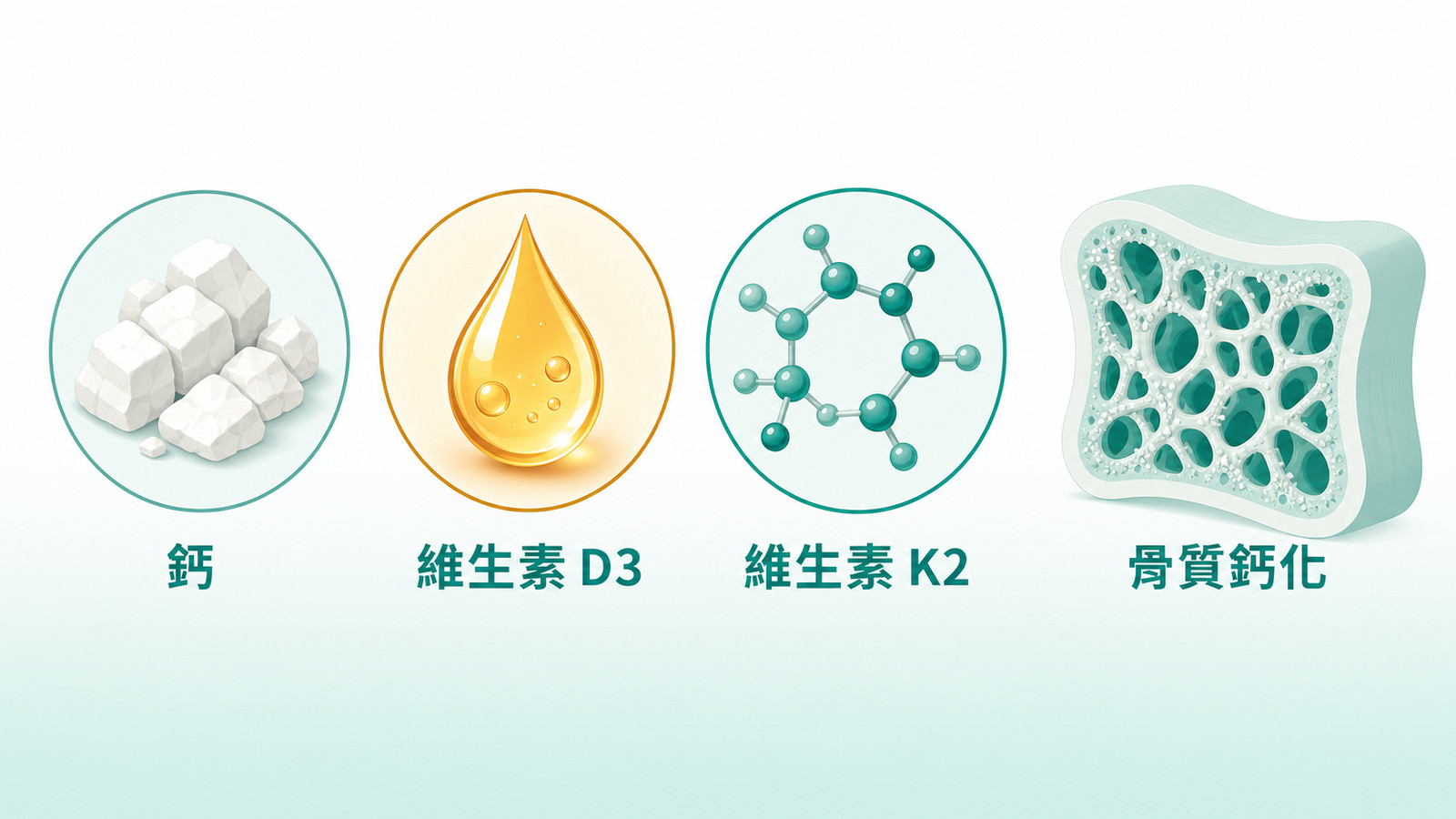
Why Should Calcium in Menopause Supplements Be Paired with Vitamins D and K?
Many people buy only calcium when they want to supplement it, but calcium during menopause is best paired with vitamins D and K. Think of vitamin D as the hands that carry groceries into the kitchen. Without it, calcium remains at the intestinal door and cannot enter. Vitamin K, meanwhile, is involved in bone calcification.
If interpretation indicates that bone nutrition deserves attention, BLNC may combine milk calcium with vitamins D and K in the foundational first 15 days. In this formula, vitamins D and K are key to helping the body use calcium, and both are provided in substantial amounts. Calcium is the building material for bone, while D and K participate in calcium absorption and bone calcification, respectively.
▸ How do calcium and vitamins D and K divide the work in the body?
After activation by the liver and kidneys into 1,25(OH)₂D, vitamin D becomes a key regulator of active intestinal calcium absorption. It can increase calcium absorption and contributes to the normal development of bones and teeth. When vitamin D is insufficient, the rate of active calcium absorption is notably lower (Holick, 2007). Vitamin K contributes to bone calcification, making calcium more likely to deposit in the bone matrix and be used in the right place (Booth, 2009). In BLNC Milk Calcium, both vitamin D and vitamin K reach the Daily Reference Value (vitamin D 150% and vitamin K 100%), so these two perform the primary supportive roles for bone while calcium is supplied as building material. A common question is whether taking too much calcium at once reduces absorption. That concern primarily applies to high-dose calcium tablets that provide several hundred milligrams per dose. BLNC does not focus on maximizing the amount of calcium. It combines an absorbable portion of calcium in one daily packet taken with a meal and relies on vitamins D and K to help the body use it. The important question has never been how much calcium you consume, but how much you use.
People often ask whether milk calcium or algae-derived calcium is better, but neither is a universal winner. Milk calcium has a high calcium density and makes dosage easy to calculate. Algae-derived calcium naturally comes with minerals such as magnesium and represents a different approach.
The practical differences are more often calcium content, gastrointestinal tolerance, and ease of swallowing—not a dramatic divide in absorption. BLNC's calcium formula combines milk calcium with vitamins D and K, and the two-layer interpretation determines whether it enters your monthly plan. When choosing a calcium source, also consider whether your digestive system tolerates it and whether it is easy to swallow. Begin with tolerance, not an absorption-rate contest.
▸ Do calcium carbonate, milk calcium, and algae-derived calcium really differ greatly in absorption?
Common calcium salts, including calcium carbonate, calcium citrate, and milk calcium, and algae-derived calcium are generally considered to have relatively modest differences in absorption under controlled conditions. Calcium carbonate should be taken with a meal and relies on stomach acid to aid dissolution, while calcium citrate is less affected by stomach acid. Differences often arise from elemental calcium density, gastrointestinal tolerance, and excipients rather than one source being superior in every respect. Algae-derived calcium naturally includes trace minerals such as magnesium, which is a tradeoff in formulation. The choice should return to your gastrointestinal tolerance and overall formula needs, not which advertisement makes the loudest claim.

Milk Calcium vs. Algae-Derived Calcium
Why do bone-health indicators appear stable in some people who take calcium consistently while others still need monitoring? Part of the answer lies in genetics.
The body has a vitamin D receiver called VDR that influences your tendency to use vitamin D and calcium. Everyone has a different version of VDR. For some, the door opens wider and deliveries enter smoothly; for others, it is narrower and more difficult to pass through. Whether calcium and vitamin D should be prioritized, how vitamins D and K should be combined, and which formulas should come first vary from person to person. One combination should not be copied by everyone. Official standards such as the Ministry of Health and Welfare's DRIs specify daily amounts; genetics concerns form and priority, not instructions to consume more.
▸ How does the VDR gene affect calcium absorption, and can the conclusion be definitive?
The VDR, or vitamin D receptor, gene has several common individual variants. In theory, they may affect the receptor's response to activated vitamin D and in turn influence tendencies in calcium absorption and bone density. However, research findings are not consistent. The direction of association varies by population, intake, and study design, and evidence is still accumulating (Uitterlinden et al., 2004). Genetic testing here is therefore a personalized reference. It helps assess whether calcium and vitamin D deserve priority, how vitamins D and K might be paired, and which formulas should be prioritized. DRIs remain the shared standard, and genetics is not used to change how many milligrams you should take. These associations are correlational and should not be treated as causal.
What do menopause supplements actually look like? BLNC does not offer a one-size-fits-all menopause product. Instead, it gives you 6 formulas each month: probiotics are standard, and your genes select the other 5.
The foundational category establishes a baseline in the first 15 days, with milk calcium often combined with vitamins D and K. The enhanced category adjusts according to genetics during the second 15 days, establishing the foundation before going deeper. Behind this interpretation, BLNC is developed by Insight Genomics Inc., a genetic-testing company built on technology transferred from National Cheng Kung University. Its R&D team has focused on genetic nutrition interpretation for years, and its own laboratory personally oversees every step from specimen handling to analysis, helping make your supplementation choices clearer and more reassuring. For a more complete look at nutrition across menopause, see this guide to women's supplements.
▸ How are the foundational first 15 days and enhanced second 15 days divided?
The foundational first 15 days—1 vitamin, 1 mineral, and the standard probiotic—establish a stable daily nutritional baseline. A common mineral formula combines milk calcium with vitamins D and K, and calcium is also suitable for divided doses taken with meals. In the enhanced second 15 days, 2 enhanced wellness formulas and 1 lipid formula are adjusted to reflect genetic tendencies. Examples include enhanced wellness formulas such as ergothioneine and fucoidan or algal DHA in the lipid slot. The two stages are designed to establish a foundation before going deeper, not to separate ingredients because they compete. Taking only a few formulas each day also makes a consistent long-term routine easier.
It uses a two-layer interpretation. The first layer examines genetic tendencies related to 22 nutrients, including areas such as vitamin absorption and mineral metabolism that are visible in the report. The second layer incorporates broader genetic tendencies into an integrated interpretation, adding inborn utilization tendencies that questionnaires cannot capture.
Together, the two layers select the 6 formulas that best fit you from 11 fixed formulas. More is not better; the goal is the right amount. The sooner you determine a direction, the sooner you can focus your effort on what actually deserves attention:
▶ Want to know how your calcium and vitamins D and K should be combined? Schedule a cheek swab; it takes a few dozen seconds with no blood draw. You will receive a report on your metabolic and nutritional tendencies, helping point calcium and vitamin D supplementation in a more suitable direction. When choosing a calcium source, also consider gastrointestinal tolerance, dosage, and need.
▸ What does the second layer of the two-layer algorithm examine?
The first layer analyzes 22 nutrients across metabolic areas such as vitamin absorption, mineral metabolism, and antioxidant function, and presents the findings in your report. The second incorporates broader genetic tendencies into an integrated interpretation, adding inborn utilization tendencies that questionnaires cannot capture and helping formulas align more closely with your constitution. Together, the layers select 6 monthly formulas from 11: probiotics are standard, and genetics selects the other 5. The exact 5 can change; the total does not.
BLNC's Precision Nutrition Approach
At this point, you may be wondering which type of calcium to take and whether to add vitamin D. Rather than guessing, let your genetic tendencies provide direction.
BLNC has 11 selected formulas and gives you 6 each month. Probiotics are standard because the gut is a shared foundation, while your genes select the other 5 from the remaining formulas. 3—1 standard probiotic, 1 vitamin, and 1 mineral—establish the foundation during the first 15 days; 3 provide enhanced support during the second 15 days. These recommendations come from a two-layer integrated interpretation of 22 nutrients and broader genetic tendencies. The intersecting information can be obtained only through testing, not questionnaires. Calcium supplementation during menopause is only one part of this approach. For a complete explanation, see this overview of genetic precision nutrition.
If interpretation indicates that calcium and vitamin D deserve attention, the Milk Calcium with D & K formula may be placed in your foundational stage.
Everyone receives probiotics. The other 5 formulas are selected through your two-layer genetic interpretation. Do not miss what you need or buy what you do not. Instead of spending more years choosing bottles and continuing to guess, begin with a single cheek swab and establish a direction:
- Schedule a cheek swab; it takes a few dozen seconds with no blood draw: After collection, your genetic tendencies are interpreted to guide the combination of your menopause supplements.
- Receive your 6 personalized formulas: One standard probiotic plus 5 genetically selected formulas in a monthly cycle, beginning with the foundational first 15 days.
A genetic report is a reference that helps you understand your body. It is not a medical diagnosis and cannot predict whether you will develop a disease. Supplements provide daily nutrition, not medication, and cannot prevent, improve, or treat disease. A stable foundation is the priority. If you have a family history or health concern, consult a specialist who can assess your complete circumstances, then arrange everyday nutrition with greater confidence and direction.
Is more calcium always better during menopause?
No. The body has a limit on the amount of calcium it can absorb effectively at one time. Swallowing a large amount of high-dose calcium at once can lower the percentage absorbed. Rather than pursuing a high dose, BLNC combines calcium in an absorbable portion, vitamin D to support absorption, and vitamin K to contribute to bone calcification. This is more practical than simply increasing the amount.
If I already take calcium, do I still need genetic testing?
Genetic testing helps you understand your tendencies in using vitamin D and calcium and serves as a reference for choosing their combination rather than switching brands based on guesswork. It is a tool for better understanding your body.
Which is more suitable during menopause: milk calcium or algae-derived calcium?
Neither is an absolute winner. Milk calcium has a high calcium density and makes dosage easy to determine. Algae-derived calcium naturally includes minerals such as magnesium. This is a general comparison of calcium sources. BLNC's formula combines milk calcium with vitamins D and K, and the two-layer interpretation determines whether it enters your monthly plan. Gastrointestinal tolerance should also be considered when choosing a source.
Does BLNC offer a menopause-specific formula?
There is no standalone, one-size-fits-all menopause formula. The 11 formulas are neutral, and the two-layer algorithm uses genetics to select 6 each month: probiotics are standard, and genetics selects the other 5. Milk Calcium with D & K is a possible bone-nutrition combination in the foundational stage. Its inclusion depends on both the two-layer interpretation and gastrointestinal tolerance rather than being assigned automatically by age.
References
- Holick MF. Vitamin D deficiency. New England Journal of Medicine. 2007. PMID:17634462
- Riggs BL, Khosla S, Melton LJ 3rd. Sex steroids and the construction and conservation of the adult skeleton. Endocrine Reviews. 2002. PMID:12050121
- Uitterlinden AG, Fang Y, van Meurs JB, Pols HA, van Leeuwen JP. Genetics and biology of vitamin D receptor polymorphisms. Gene. 2004. PMID:15315818
- Booth SL. Roles for vitamin K beyond coagulation. Annual Review of Nutrition. 2009. PMID:19400704


